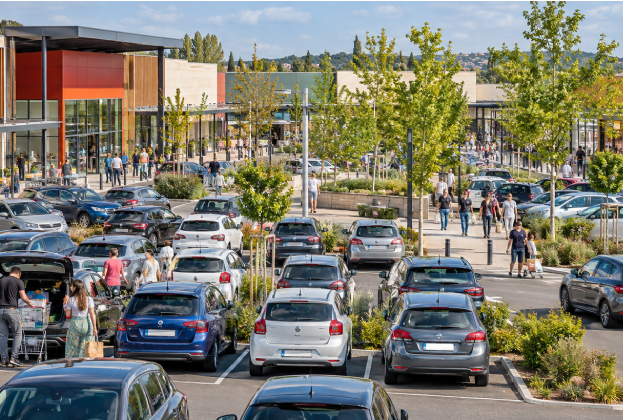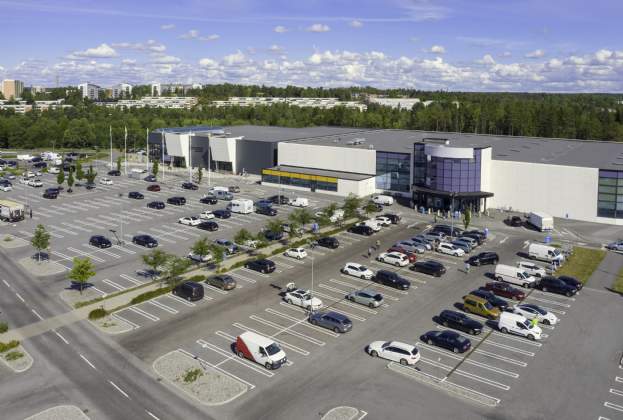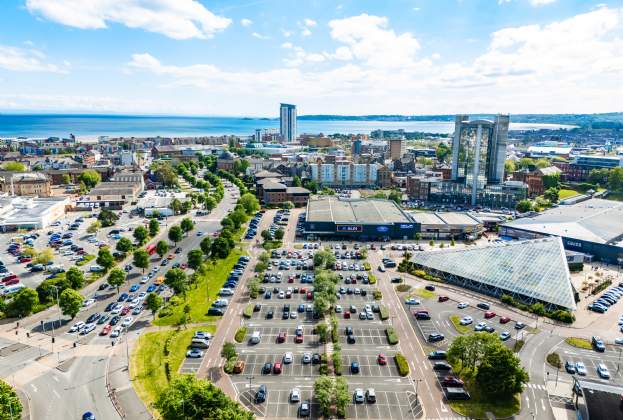
Resilient income and attractive pricing underpin retail park investment, as cross-border capital supports larger deals.
Out of town, a bright spot
European real estate investment remains subdued heading into the final quarter of 2026, despite stronger-than-expected economic growth, improved investor confidence, and supportive occupational fundamentals. Q3 volumes reached approximately €43bn, down 10% year on year, bringing the total for the first nine months to €154bn, a modest 4% increase on the same period in 2025. Retail attracted €23bn of investment in the first nine months of 2026, down 13% year on year. The decline primarily reflects a shortage of assets available for sale rather than weaker investor appetite for the sector.
Retail parks and warehouses remain a key focus for investors, supported by an attractive risk-return profile relative to other asset classes and notably strong total return performance recorded by MSCI (7.4% in 2025). Investment in the segment accelerated in Q3, reaching slightly more than €2bn, a 91% increase on the same period in 2025. This brought volumes for the first nine months to €5.3bn, down approximately 7% year on year. The decline reflects a particularly strong start to 2025, when several large portfolio transactions in Germany, the UK and Ireland boosted activity. The segment’s growing appeal may also be reducing owners’ willingness to sell assets they view as defensive and offering an attractive balance of risk and return, particularly where compelling reinvestment alternatives are scarce.
Capital moves out of core
Core European markets still attract substantial capital, but they no longer dominate the sector as they once did. Their combined share of retail warehouse investment declined from 80% in 2021 to 48% during the first nine months of 2026. Over the same period, Central and Eastern Europe and Southern Europe increased their combined share from 14% to 46%.
This is more than a temporary redistribution of transactions. Investors are increasingly willing to look beyond the largest and most liquid markets when underlying assets offer attractive income, established tenant demand, and pricing that compensates for added market risk.
Poland, Spain, Romania and Italy were among the clearest beneficiaries. Poland attracted €667m during the first nine months, 172% more than a year earlier and 257% above its five-year average. Q3 alone contributed €374m, supported by the sales of six Vendo Parks and Power Park Kielce.
Spain recorded €615m, up 225% year on year and 113% above its five-year average. NEPI Rockcastle’s acquisition of MegaPark Barakaldo helped lift third-quarter investment to €253.8m, following transactions earlier in the year including the €40m sale of Meixueiro Retail Park.
In Romania, investment rose to €376m, 449% above the same period of 2025 and 479% above the five-year average. Portfolio transactions drove this increase, including the six-property Value Centre portfolio and ten Brico Dépôt stores. Italy also recorded a marked rise, with €252m invested over the first nine months, up 96.3% year on year and 131% above its five-year average.
Cross-border capital is playing a growing role in European retail park investment, supporting larger deals and portfolio acquisitions.
James Burke, Director, Global Cross Boarder Investment
Cross-border capital raises the stakes
Larger deals and portfolio transactions are increasingly shaping European retail warehouse investment, supported by a higher share of cross-border capital than historically. In the first nine months of 2026, average individual deal size reached €23m, compared with €19m over the previous five years, while portfolios accounted for approximately 40% of investment volumes.
The changing capital mix is helping support larger lot sizes. Foreign buyers invested an average of €21.5m per property, compared with €14.2m for domestic purchasers. However, larger transactions have not yet been matched by a widespread increase in transaction numbers, suggesting activity remains concentrated in sizeable opportunities.
Several acquisitions illustrate this trend. In Spain, Ares Management acquired Castellana Properties’ retail park portfolio for €279m. AFI Europe’s acquisition of MAS’s Romanian portfolio provides another example, covering six retail parks and two extensions with a combined asset value of €281.8m.
Cross-border demand for European retail warehouses and retail parks has strengthened, even as foreign investment in the wider European real estate market has slowed. Overseas buyers accounted for 52% of investment volumes in the first nine months of 2026, above the five-year average.
North America led overseas investment, accounting for around half of cross-border volumes, while European investors contributed less than their long-term average. Alongside this geographical shift, several major core investment managers have returned to the sector, including US groups Hines, Barings and Nuveen, and European managers Aberdeen, PATRIZIA and Savills Investment Management. Hines’ recent acquisitions in France and Portugal illustrate this renewed appetite, while British Land has also resumed investment in UK retail parks. Middle Eastern and Israeli capital has become more prominent, accounting for around a fifth of overseas investment, although AFI Group’s acquisition of a Romanian portfolio heavily influenced this share.
Domestic investors continue to play an important role, including through sizeable acquisitions by Frasers Group in the UK and Delcore Fastigheter in Sweden. Local pension funds and private wealth are particularly important where foreign activity has weakened.
Equity gains the upper hand
More demanding financing conditions are progressively reshaping the investor mix in the European retail warehouse landscape. Buyers with available equity and limited borrowing requirements, including pension funds investing directly and equity funds pursuing low-leverage strategies, are better placed to remain active. For more highly leveraged investors, including some developers and managed property funds, higher borrowing costs and selective lending are making acquisitions and refinancing more difficult, prompting some owners to sell assets. Listed REITs have predominantly been sellers, although several have continued to deploy capital in the sector.
Over the past 12 months, pension funds recorded the strongest net buying, well above their two- and five-year averages. Banks also increased their net acquisitions, while equity funds moved from net selling to net buying. Private REITs remained net purchasers, although at a slower pace.
At the other end of the spectrum, listed REITs and developers became net sellers. Insurers increased their net disposals, and investment managers continued to reduce their exposure. Buyers’ capacity to invest increasingly depends on how they fund acquisitions, rather than on investor type alone. Those able to commit equity for the long term have greater flexibility than those whose strategies rely more heavily on debt availability or refinancing conditions.
Retailers themselves are also influencing ownership patterns. Some are acquiring properties they previously occupied as tenants, while others continue to develop and own their premises. This is particularly visible in parts of Central and Eastern Europe, including Jumbo's acquisitions of occupied properties and the established ownership model of several large DIY retailers. These decisions allow occupiers to exercise greater control over strategically important locations.
From removal to renewal
The investment case for European retail warehouses is increasingly centred on the resilience of income from value and convenience retailers. Price-conscious shoppers drive demand for space from these retailers, while relatively affordable occupation costs, compared with other retail segments, help them expand. For investors, this strengthens the appeal of operational assets with established tenants and scope to improve their performance.
In the aftermath of the pandemic, rapid growth in online sales raised questions about the prospects for some retail sites. This drew investment towards properties that could be converted to other uses or cleared for redevelopment, removing them from the retail warehouse stock.
As online sales growth slowed, this activity has receded: acquisitions for conversion or demolition accounted for 0.4% of investment in the first nine months of 2026, down from 1.4% in 2025 and below the five-year average of 2.2%. Renovation has become the more prominent value-add strategy, rising from 0.3% of investment in 2025 to 3.7% in the first nine months of 2026, above its five-year average of 1.1%.
Forward purchases remain limited. High construction costs, scarce suitable land, and construction delays make it harder to deliver new schemes. They remain viable where tenant demand supports new space, including Sweden and where existing provision is low, such as in Central and Eastern Europe.
Investment rationale is shifting towards making existing assets perform better, with active management stimulating occupier demand, supporting rental growth and strengthening income resilience.
Lydia Brissy, Director, European Research
Retail warehouse pricing holds its ground
Fluctuations in bond yields and borrowing costs are prompting property-price adjustments, but rental income continues to underpin real estate returns. Across many sectors and markets, rising rents are helping to partially offset the pressure on values. With return expectations already centred on income growth and asset performance, and less reliant on falling interest rates to lift values, the underlying investment case remains relatively intact.
Retail warehouses have demonstrated particular resilience against this backdrop. The average prime yield edged down from 5.73% in Q2 2026 to 5.72% in Q3, driven by compression in Stockholm, while yields held steady in all other markets. Retail warehousing was the only commercial property sector to record inward movements quarter-on-quarter (-1 bps) and year-on-year (-5 bps). All other sectors recorded outward movements.
This divergence reflects strong investor demand and competition for retail warehouse assets. Comparatively attractive pricing against most other property types adds to the appeal of prime assets, supporting renewed appetite for the retail warehouse sector.
We expect prime retail warehouse yields to remain broadly stable over the next 12 months, with some outward movement in a few jurisdictions, particularly in core markets (UK, Germany and France).
Read the other articles within European Retail Warehousing below