

To help farmers boost their productivity in preparation for an unsubsidised future, a new round of the Countryside Productivity Scheme has opened in England.
It offers £15 million to support investment in productivity boosting technology. The Government has received its second report from the Office of Tax Simplification on inheritance tax and a number of its recommendations could have implications for tax strategies. Elsewhere scientists argue that major afforestation is the number one strategy to tackle climate change, whilst the Communities Secretary has called for the beauty of buildings to be given a greater weighting in planning decisions to avoid estates of identikit homes.

FOOD & FARMING
Grant funding: Countryside Productivity Scheme opens
Farmers in England can now apply for grant funding to support the purchase of specific equipment and technology to boost the productivity of their farm. Round two of the Countryside Productivity Small Grant Scheme has a £15 million budget and will fund 40% of the standard cost of eligible items (listed on pages 47-66 of the guidance). These include cattle handling equipment, badger proof feed troughs, GPS and precision application technology. The minimum grant size is £3,000 and maximum £12,000. Those who were awarded funding under round one of the scheme can apply for further funding, but the total value of both applications must not exceed £12,000. Applications can be made until midday on 3 September through an online portal. If successful, farmers must buy, install and claim their funding within 150 calendar days of the date of receiving notification that their application has been successful.
If you would like to discuss making an application please contact Stuart Nicholls.
Abolishing subsidies could be delayed
Brexit uncertainty could see the abolition of direct support delayed by a year. Phasing out was due to begin in 2021 over seven years. The Agricultural Bill has been stalled in Parliament since November and does not look likely to progress until autumn at the earliest. NFU president Minette Batters is looking for a “delay in the agricultural transition until we have more certainty”. She said it would be “extremely dangerous” to see payments phased out faster in England than the rest of the UK. When asked if there would be a delay, Mr Gove said the sooner the Bill was on the statute books, the better but that it was in the hands of parliament.
Call for evidence on flooding
The Government is calling for evidence that it can use in developing its policy on floods and coastal erosion for England. The risk of both will increase in the future due to population growth and climate change. Over the next six years £6 billion will be spent on new projects as well as £1 billion by 2020 to maintain current defences. The call for evidence covers topics such as adapting to coastal change, corporation tax relief for business contributions to flood defence projects and local funding initiatives for flood risk management. Recent flooding events such as at Wainfleet in Lincolnshire highlight how important it is for rural businesses to make sure their views are taken on board. The deadline for responses is 19 August.
EU and Mercosur trade deal
After 20 years of negotiations, the EU and South American trade bloc Mercosur have signed a bilateral trade deal. The pact represents a free trade area of 773 million people and a combined GDP of €19 trillion. Once implemented, European businesses will save an estimated €4 billion on duties each year. Both Commission chief Jean-Claude Juncker and Trade Chief Cecilia Malmström said the signing of the deal was an “historic moment”. The deal is expected to be applied around 2028 after legal inspection and ratification.
Farm Commissioner Phil Hogan was not so upbeat and confessed to “a degree of compromise” but also “a desire to protect our more sensitive sectors”. Copa Cogeca, which represents EU farmers, went further by saying “agriculture has been the trade-off chapter to facilitate gains in other sectors”. The Irish parliament has since voted to press the Government to lead opposition in the EU. As a smaller member state, Ireland will require the support of other nations to form a blocking minority and reject the deal. The deal has been criticised as a bad deal for the environment too. Known as a “cows-for-cars” deal, it is feared it will exacerbate both deforestation and car production.
POLICY
Inheritance tax – Simplification proposals made
Inheritance tax (IHT) generates less than 1% of the Exchequer’s receipts, is paid following just 5% of deaths and it is administratively complex with IHT forms needing to be completed after nearly 50% of deaths. In January 2018, the Chancellor asked the Office of Tax Simplification (OTS) to review a wide range of administrative and technical aspects of IHT. It has now made its second report which focuses on the design of the tax.
Businesses and farms are one of three key areas for IHT simplification and the report makes a number of recommendations to Government. The relevant parts are:
Recommendation 6 (3 parts)
i.Consider if it is appropriate that the level of trading activity for business property relief (BPR) is lower than the level needed for gift holdover or entrepreneurs’ relief
ii.Review the treatment of indirect non-controlling holdings in trading companies
iii.Consider aligning furnished holiday lets treatment under IHT with their treatment for income and capital gains tax (CGT).
Recommendation 7: Review the treatment of LLPs with regards to their trading or investment classification for BPR.
Recommendation 8: Review the treatment of farmhouses in sensitive cases such as where a farmer has had to go into care.
Recommendation 9: Issue clear guidance as to when a valuation of a business or farm is required and whether it needs to be a formal valuation or estimate.
Another key area of relevance to farms and rural estates is lifetime gifts. Reform of the seven year gifting period is proposed in addition to simplification of the annual gift exemption, gifts linked to special occasions and regular gifts out of income. The OTS says the “seven year period requires a large amount of record keeping but raises little tax” so proposes it is shortened so that IHT only becomes chargeable if death occurs within five years of these gifts. It also proposes that taper relief is abolished.
The OTS’s third key area focuses on the interaction with CGT. It makes recommendations to prevent decision making being complicated and distorted, because under current rules CGT exemption on death operates in an imperfect manner and both zero taxation and double taxation are possible. For further advice on how this might impact on tax planning, please contact Clive Beer.
Farm tenancies under fire
The CLA has called the Agricultural Holdings Act (AHA) tenancy system “antiquated” and “regressive” in its response to Defra’s consultation on agricultural tenancy legislation. CLA president Tim Breitmeyer said the industry should “embrace more flexible alternatives” such as Farm Business Tenancies (FBTs) and joint ventures. He said “we shouldn’t be tinkering around the edges of a system which has fundamental flaws”. The TFA has also expressed concern around the consultation and is disappointed it “devoted so little” to FBTs. It said they are currently “short-term, restrictive in nature and overpriced”. TFA chief executive, George Dunn, was critical that a more joined-up approach wasn’t taken across government. He went on to say “if landlords who let for less than 10 years were denied access to lucrative agricultural property relief from inheritance tax, we would see improvements in average lengths of term which are currently pitiful”. The consultation has now closed. The TFAs criticism that government didn’t take a joined up approach has merit. For instance to encourage lettings the Tenancy Reform Industry Group recommended limited income tax relief on farmland rents and exempting agricultural lettings from stamp duty land tax to encourage longer tenancies. However, presumably in the interests of simplicity, Defra only took proposals forward to consultation which it could action directly, omitting recommendations which would involve the Treasury. Consequently the introduction of incentives, or removal of barriers which would help Defra achieve its objectives for the tenanted sector, were not on the table.
Conservatives set out a green manifesto
The Conservative Environment Network (CEN) has proposed measures which it thinks should form the core of UK policies to prevent climate change. The document is divided into five sections; security, prosperity, justice, responsibility and diplomacy. Some recommended policies include:
•Subsidy-free onshore wind
•Net environmental gain across new developments
•Implementing the polluter pays principle
•A commitment to high animal welfare standards
•Diverting £3 billion towards public goods once we leave the Common Agricultural Policy.
Sam Richards, director of the CEN, said the manifesto is “an exciting opportunity to set the UK on a new path”. Michael Gove, while not a signatory, confessed to being a “shy green Tory” and said a love of the environment was “at the heart of Conservatism”.
General licences – Gove gives evidence in Westminster
Michael Gove accused Natural England of “failing to deliver” new general licences after revoking those already in place. While giving evidence to the Environment, Food and Rural Affairs Committee, he defended Defra’s role in the revocation and attributed the root of the issue to decisions taken by Natural England in 2014. He confirmed that current licences published by Defra were “temporary” and Wild Justice would still look to test them, but he is confident that they would be able to resist any legal challenges. The Defra Secretary went on to say he would consider the evidence for expanding the list of birds that “might fall within the purview of future General Licences”. Defra has now published the results of its recent call for evidence on general licences. This confirms that the temporary licences will be valid until 29 February 2020. In the meantime, Defra will lead a review of the longer-term general licensing arrangements, starting with the launch of a public consultation by the end of the summer.

ENVIRONMENT & NATURAL CAPITAL
Is the UK doing enough about emissions?
Committee on Climate Change chair John Gummer has said the Government has a “ramshackle, Dad’s Army” approach to climate change. The report from the CCC said new policies have “fallen short of what is needed for previous targets and well short of those required for the net-zero target”. Only one of the 25 headline policies has been implemented in 12 months and only seven of 24 monitoring indicators were on track. Projections show this is insufficient to meet targets. The policy gap has in fact worsened as future emissions are predicted to increase by more than the impact of new emissions reduction policies.
Electric cars are not the solution…
Car use must decrease, even if they are all powered by clean energy says the Centre for Research into Energy Demand Solutions (CREDS). CREDS is formed of 80 academics from across the UK. Its report says traffic jams, urban sprawl and wasted space for parking will still be problematic. Professor Jillian Anable, one of the authors of the report, said ministers have tried “to meet demand by increasing road space… they need to reduce demand instead”. In a separate report the Government’s Air Quality Expert Group has warned that dust from car brakes and tyres will still pollute the environment even when the vehicle fleet has gone all-electric, although supporters of electric cars argue that their brakes do not need to be used as much.
…but trees could be
Researchers found that over a trillion native tree saplings could be grown across the world without infringing on urban or cropped land. Grazed land was not excluded but researchers did say there were some trees that could also benefit sheep and cattle. Tropical areas could sustain 100% tree cover while other climates would be more sparsely populated. Professor Tom Crowther from ETH Zürich, who led the research, said it was the top one of their climate change solutions. He said forest restoration would take 50-100 years to take effect, but would remove 200 billion tonnes of carbon.
Tree planting is already underway. In China, an app-based game is rewarding half a billion users for choosing low carbon activities like using public transport. When they have enough energy, they can plant a tree in a virtual forest which then translates to a real tree being planted in rural China. The Queen also took up the challenge when visiting the National Institute of Agricultural Botany just outside Cambridge, she was offered the opportunity to hand over her tree-planting duties. She politely replied “No, no, I can still plant a tree” but referring to the species, did admit “I don’t think I’ve ever planted one of these before”.
PROPERTY & DEVELOPMENT
Creating space for beauty
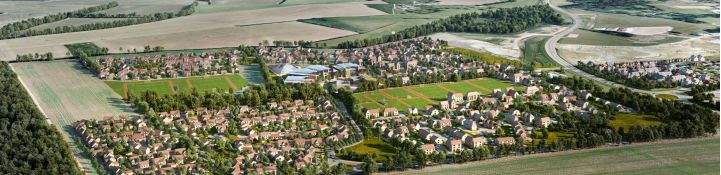
Beauty should be secured in the planning process to help end identikit homes and boxland developments. A report to government by the Building Better, Building Beautiful Commission says there should not be an assumption that “beauty is a property just of old buildings or protected parkland”. Instead, the Commission says beauty should be a “controlling aim in all that we do” and made a number of recommendations:
•Making high streets walkable, well-connected and with a greater mix of buildings
•Councils having the confidence to say no to ugliness
•Improved and earlier public and stakeholder engagement
•Financial support should “aim for beauty”.
Communities Secretary James Brokenshire said he was determined to hit house building targets but “what is built must stand the test of time”.
Wales: Extending tenancy notice periods
The Welsh Government is consulting on plans to extend landlords’ notice period for so-called ‘no-fault’ evictions from two to six months. The change would be made to the as yet unimplemented Renting Homes (Wales) Act 2016 which provides a new, streamlined and reformed basis for residential tenancies in Wales. Once in force the Act will replace existing models of tenancies, including Assured Shorthold Tenancies. The Government would like to remove ‘no-fault’ evictions, but legislative timetabling constraints means it is instead seeking to extend the notice period at this point. The consultation runs until 5 September.

BUSINESS & ECONOMY
Scotland: Back payment pledge from Boris
Conservative leadership hopeful Boris Johnson has pledged an extra £25 million a year for Scottish farmers after Brexit. He called the distribution of £190 million of EU Convergence Uplift payments across the UK a “historic injustice”. While he criticised the entire CAP policy, he said “Scottish farmers have been particularly poorly treated”. In response, he would offer farmers in remote areas the same per hectare payment as the UK average. It comes after his leadership rival Jeremy Hunt promised a £6 billion Brexit package for farming and fisheries.
Innovations receive funding
A £22 million Government investment will help UK farmers cut emissions, pollution and waste while producing more food. Industry partners will contribute a further £8.8 million. 31 projects will benefit from the Industrial Strategy’s Transforming Food Production Challenge funding; they include underground scans, electrical weed control and GPS tracking for livestock.

OTHER RURAL NEWS
And finally…
Putting the green in Forest Green Rovers
Forest Green Rovers is the first carbon neutral football club in the world. From a 100% vegan match-day menu to a stadium entirely powered by renewable energy, the 130-year-old club achieved its UN-certified status in less than a decade. The pitch is organic, the t-shirts are 50% bamboo and supporters are encouraged to car-share. When the club was in financial trouble in 2010, Dale Vince was appointed as chairman. Mr Vince founded Ecotricity, a green electricity supplier. He said the change had been “pretty straightforward because we approached this from a point of view of passion”.