
Key challenges and opportunities facing development in the East of England took centre stage for Savills annual Eastern Region Development Seminar.
More than 100 clients – including landowners, housebuilders, developers and promoters – attended the event, which is held every year at the Jockey Club in Newmarket.
Chaired by head of Savills Cambridge Tom Fraser, the event included presentations on a range of topics.
It began with a talk by James Rolton – investment director at British Land – who outlined his firm’s vision and discussed Cambridge’s potential for future development.
“Cambridge is different to a lot of cities in the UK because there is real appetite for growth. A lot of organisations are pushing in the same direction,” he said.
While there was a very real need for more affordable homes to help accommodate the city’s growing workforce, the continued demand for life sciences and the supply and demand imbalance for commercial space meant there were good opportunities for investment, he added.
“There’s huge potential to create game changing places of high quality for generations to come. Many of the organisations we speak to want to see best in class development and are very positive,” James said.
Attendees also heard from Dr Lucy Greenwood, a director in the Savills residential research team, who discussed the firm’s five year housing forecasts.
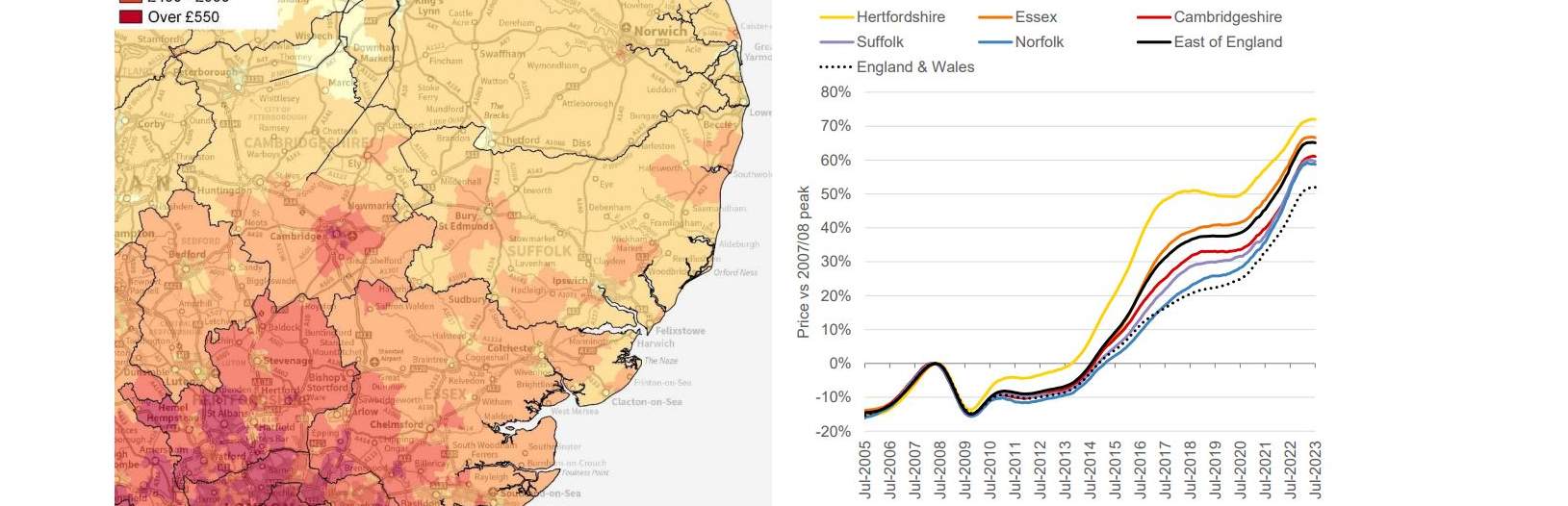
Mainstream house prices are expected to fall 3% across the UK next year, according to Savills, with five year growth of 17.8% by 2028. In the East of England prices are expected to drop by 3.5% over the next 12 months – rising by 16.7% in the next five years. However there may be some areas – strong employment centres such as Cambridge or coastal hotspots for example where demand remains strong relative to supply – that perform differently to the rest of the market.
“The worst of the house price falls look to be behind us, but the first cut to rates still looks to be some way off. This means continued affordability pressures are likely to result in further modest house price falls over the first half of 2024,” Lucy said.
“However an expectation of a gradual reduction in interest rates suggests a steady recovery in demand. We should see price growth accelerate as affordability pressures ease, with the strongest increases forecast for 2027. From there we expect growth to settle at a rate broadly in line with income growth.”
Lucy also discussed the growing demand for new homes in the region and the various challenges that housebuilders face, including pressures on grid capacity, issues around nutrient neutrality and the growing need to account for biodiversity net gain (BNG).
In the last talk of the afternoon, Andy Moffatt, head of planning at Savills Cambridge, outlined some of the key planning themes in the East of England for the year ahead.
Topics included BNG, changes to Local Plans, the Levelling Up and Regeneration Act and the potential impact of a General Election on planning policy.
The seminar concluded with a Q&A session chaired by Richard Shuldham, from the Savills Norwich Development team, that featured all the speakers alongside Abigail Jones and Ben Sinclair, from Savills Development teams in Cambridge and Chelmsford respectively.
Speaking after the event Richard Janes, head of Development at Savills Cambridge, said: “Our development seminar is always well attended and I would like to say a big thank you to everyone who took the time to give such informative presentations. With so much political and economic uncertainty of late there was no better time to get in front of our clients and offer our views on current market conditions. As ever the feedback has been very encouraging and the presentations very well received. The event touched on some highly important issues that will continue to shape development and planning in the East of England for many years to come.”