Land in England is finite, yet it underpins our economy. In one way or another, many of the country’s biggest priorities come back to rural land. Pressures have never been greater: maintaining food and energy security, delivering growth and development, and restoring nature. Defra’s 2025 land use consultation set out a vision for England’s first Land Use Framework (LUF), using data and stakeholder feedback to create a framework that does not prescribe specific land uses in specific places, but instead informs land use decisions rather than imposing them.
The short answer to this is apparently yes according to the recently published Land Use Framework – provided we use it more efficiently and in a multi-functional way.
Defra has now published the LUF, a significant step forward. By bringing competing demands and constraints into a single document, it helps build a clearer understanding of the trade-offs that must be managed when making land use and development decisions. A consistent message is the need for strategic choices at a national level, echoed by the shift towards Local Nature Recovery Strategies (LNRS) and Spatial Development Strategies (SDS), which Savills has previously commented on. The framework describes how land is used today and the changes needed to meet rising demands. It is a welcome starting point that brings structure to the debate, but the scale of land use change required means the journey is far from complete.
Agricultural land use change
Given the pressures of climate change, development and afforestation ambitions, and with farming still England’s dominant land use, accounting for nearly 70% of the land mass, some reduction in farmland area looks inevitable. Defra’s analysis suggests that, for the LUF to meet its 2050 ambitions, land use or management would need to change across around 12% of England’s land (or 18% of its farmland).
Over the next 25 years, around 13% of England’s agricultural land is expected to move out of agricultural use. Even so, the LUF makes a “clear, long-term commitment to maintain overall food production in England, to underpin our future food security and drive economic growth”. It proposes doing so by safeguarding the most productive land, steering development away from the “best and most versatile” agricultural land, and relying on productivity gains, which Defra calculates will be sufficient to offset the loss of land.
Multi-functional land uses
The framework sets out short-term and long-term visions across several themes, including housing, communities, clean power and infrastructure. Across these, there is a recurring message about “smarter” land use decisions, focused on multi-functional land, e.g. land that can facilitate development while also delivering nature recovery. The draft National Planning Policy Framework (NPPF), which guides local authorities and developers in creating sustainable and well-located development, touches on this in relation to nature recovery. LNRS measures, for example, should be seen as opportunities to embed nature recovery within development rather than as precluding development. Often, such measures are easily factored into green/blue infrastructure design across development sites – it just requires strategic thinking and early consideration in the masterplan process.
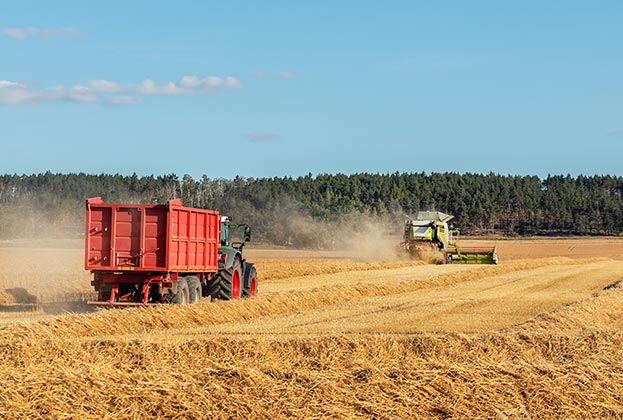
Ultimately, higher adoption of multi-functional land uses will minimise the amount of radical change needed. Farming can flex too. Regenerative farming practices, supported by schemes such as the Sustainable Farming Incentive and by supply-chain premiums, show how farm businesses can produce food while improving soil health, boosting biodiversity, and building long-term resilience. Nature and farming need not be mutually exclusive, as has often been assumed.
Safeguarding the most versatile agricultural land
A consistent message throughout the LUF is the need to adopt more sustainable and regenerative farming practices. Done well, these approaches can protect and, in some cases, improve yields while also enhancing biodiversity. Both the LUF and the draft NPPF emphasise safeguarding the most versatile and productive agricultural land, but this does not mean it cannot contribute to nature recovery – for example, through arable field margins and other agri-environment scheme options.
So what tough questions can farmers, landowners and developers ask themselves to deliver on the framework’s ambitions?
-
Am I getting the most out of my land?
-
Am I speaking to the right experts to consider alternative land uses and management practices?
-
Is doing nothing or the minimum good enough in the long term, both for landowners and investors? Are we creating long-term resilience or short-term fixes?
There are no quick answers to any of these questions, but they should form a starting point for making decisions about land use in England.
.jpg)
.jpg)