Conviction strengthens, but supply constrains volumes
KEY TAKEAWAYS
Investment
- Investment activity is recovering, but stock remains the constraint: Q3 volumes reached £485 million, more than double Q2 and 6.4% ahead of Q3 2025, although year-to-date volumes remain 29% lower at £1.45 billion.
- Prime pricing continues to demonstrate institutional conviction: Prime open A1 and restricted yields remain at 5.25% and 5.75%, with recent institutional bidding on prime South East assets moving toward the 5% range despite higher gilt yields and borrowing costs.
- A clearer pricing divide is emerging: Low-cost institutional equity continues to compete strongly for prime assets, while higher borrowing costs are placing greater pressure on the more debt-dependent secondary and value-add market.
- Capital is available to transact at scale: The five largest deals accounted for approximately £622 million, or 42% of investment, demonstrating that the market can once again accommodate sizeable individual assets and portfolio transactions.
- Hines has become one of the year’s dominant institutional buyers: With in excess of £300 million committed across multiple acquisitions, its activity demonstrates growing international institutional confidence in the sector’s low vacancy, resilient income and rental-growth prospects.
Investment activity rebounds after the mid-year lull
Retail warehouse investment rebounded in Q3 following a quieter second quarter, when the onset of the Iran conflict, higher energy costs and increased financial-market volatility caused some investors to pause. Q3 volumes reached £485 million, 6.4% above Q3 2025 and more than double the £242 million recorded in Q2.
Nevertheless, the temporary slowdown has weighed on the year-to-date total. Investment reached £1.45 billion during the first three quarters of 2026, 29.0% below the £2.04 billion transacted over the same period last year. This reduction reflects constrained stock flow and disrupted transaction timing rather than a material weakening in appetite. Demand remains active across both institutional and non-institutional capital, but the pipeline has become more sporadic, with no single source of vendors replacing the earlier sell-down by retail funds and defined-benefit pension schemes.
This leaves the market in a relatively unusual position: buyer appetite is strengthening, but investors are increasingly asking where sufficient stock will come from to sustain a £3 billion annual market. Realty’s extensive ownership of higher-yielding retail warehouse assets may be contributing to the shortage, with fewer properties returning to the market several years after its initial accumulation phase. However, constrained stock should not be interpreted as automatic support for all pricing. Buyers remain highly selective, particularly outside the prime segment.
Pricing increasingly divides between prime and the rest
The market is no longer moving through a gradual prime-to-secondary pricing curve. Instead, a clearer divide is emerging between institutional-quality assets, which benefit from low-cost equity, and those dependent on debt-backed purchasers.
Prime open A1 and prime restricted yields have remained stable at 5.25% and 5.75%, respectively, during 2026. More recent bidding evidence on prime South East assets has seen multiple institutional bids at sub-5.25% yields, suggesting pricing for the strongest stock may be beginning to compress. Competition is being led by local government pension schemes and institutional managers including Aberdeen, Schroders and DTZ Investors.
The picture is less certain beyond prime. Secondary open A1 and restricted yields have moved out by 25 basis points (bps) to 8.25% and 8.50% respectively, while limited transactional evidence elsewhere makes it harder to establish where pricing has settled. The market between approximately 6.5% and 8.0% has been particularly affected by the rising cost of debt, with some geared buyers becoming more selective as their required returns have increased.
This divergence largely reflects changes in financial markets rather than weaker retail warehouse fundamentals. The ten-year UK gilt yield increased from 4.46% in January to 5.20% in August, while the five-year gilt rose from 3.92% to 4.80%. Ordinarily, the increased return available from lower-risk government debt would put upward pressure on property yields. The fact that prime retail warehouse yields have remained stable despite this movement is therefore a strong indication of institutional conviction in the sector and its income-growth prospects. By contrast, higher borrowing costs have had a greater impact on geared investors, who require a sufficient margin between their cost of debt and the return available from an asset, putting greater pressure on pricing in the secondary and value-add market.
The result is firm prime pricing rather than widespread yield compression. The best assets continue to attract multiple bidders and achieve yields between approximately 5.25% and 5.75%; institutionally acceptable stock immediately below that level can still command competitive pricing, but the next pool of capital may require an additional yield premium of around 150 bps. Comparatively little capital currently occupies the space between the two.

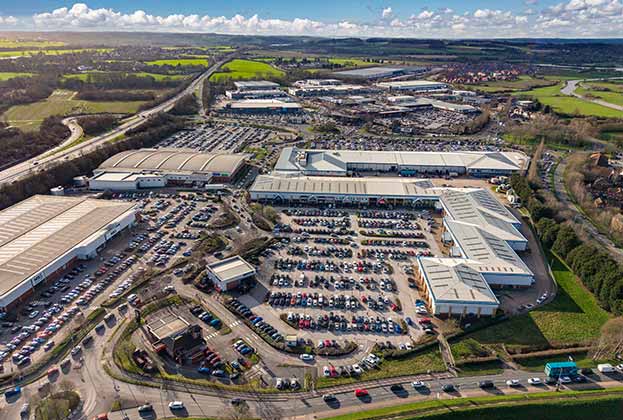
GREAT EASTERN RETAIL PARK, ROTHERHAM
Scale returns to the market
Despite lower year-to-date volumes, several major transactions demonstrate that investors are once again prepared to deploy capital at scale. The largest was Realty’s £232.95 million acquisition of an eight-asset portfolio from Tristan, reportedly at a 7.75% corporate yield. Other significant deals included Ashtrom’s £102.5 million acquisition of Retail World Team Valley at a 7.5% corporate yield and NewRiver’s £73.5 million purchase of The Springs in Leeds at 7.12% net initial yield (NIY).
The five largest transactions accounted for approximately £622 million, equivalent to 42% of recorded investment. This concentration shows that the market can once again support major portfolio and individual-asset transactions, rather than relying predominantly on smaller private-property deals. It also demonstrates liquidity across different strategies: lower-yielding institutional assets are attracting core capital, while portfolios and assets capable of generating higher initial returns continue to appeal at yields closer to 7.5%–8.0%.
Pricing remains dependent on the quality and durability of the income. Investors are differentiating according to location, tenant mix, lease length, rental affordability, capital expenditure requirements and the ability to unlock asset-management opportunities. The return of larger transactions therefore signals growing conviction, but not a wholesale return to pre-2022 pricing.
Hines becomes one of the year’s dominant buyers
Hines has emerged as one of the most acquisitive institutional investors in UK retail warehousing during 2026, committing in excess of £300 million across several meaningful transactions. Its largest investment involved the acquisition of Nugent Shopping Park in Orpington from British Land for a price in the order of £85 million. Further acquisitions on behalf of the Hines European Core Fund included Altrincham Retail Park and Straiton Retail Park in Edinburgh, both acquired from ARES.
Hines has also acquired Newbury Retail Park from Starwood Capital, alongside further retail warehouse investments during the year. Its acquisitions span different locations, lot sizes and yield profiles, but share a focus on strong catchments, constrained supply and the potential to capture rental growth through active management.
The scale of this commitment is significant. While many traditional UK institutional funds, investment managers and LGPS mandates have tended to acquire individual assets more selectively, Hines has pursued a broader accumulation strategy, building meaningful exposure to the sector across multiple acquisitions. Its activity demonstrates that major international institutional capital is prepared to build exposure to retail warehousing at scale rather than treat the sector as a tactical allocation. It also provides a direct link to the occupational story: low vacancy, resilient income and constrained development are increasingly supporting the investment case.
Asset management could unlock the next phase of growth
The shortage of occupational churn presents both a strength and a complication for investors. High occupier retention protects income and supports values, but it also limits landlords’ ability to regain possession, improve tenant mixes and establish new rental evidence. Investors do not require continuous churn, but they need periodic opportunities to demonstrate reversion and deliver their business plans over a typical five-year hold period.
Retailer restructuring can therefore create asset-management opportunities without materially undermining the wider investment case. Poundland’s 122 retail warehouse stores extend to approximately 1.3 million sq ft; even if all were returned to the market, vacancy would rise only from 3.9% to around 4.3%, broadly where it stood at the end of 2025. In practice, better-located stores are likely to attract interest from expanding value, grocery, home and leisure operators.
Any release of space could provide landlords with opportunities to improve covenants, reconfigure units and establish fresh rental evidence. However, these benefits will be highly asset-specific. Vacancy may support value creation on the right scheme, but weaker locations and poorly configured units could require capital expenditure and longer reletting periods.
Investment outlook
Prime pricing holds as investment demand strengthens
The sector enters the final part of 2026 in a position of stability. Institutional demand is increasing, geared capital remains available where pricing provides sufficient headroom over debt costs, and the occupational fundamentals continue to compare favourably with other commercial property sectors. The principal constraint is the availability of investable stock rather than the availability of capital.
Prime assets should continue to attract strong competition and could experience selective yield compression where multiple institutional bidders converge. However, elevated gilt yields and borrowing costs make broader-based hardening unlikely. The divide between low-cost institutional equity and debt-dependent purchasers is consequently likely to remain a defining feature of the market, sustaining firmer pricing for the best assets while placing greater pressure on secondary and value-add opportunities.
Volumes may therefore remain uneven from quarter to quarter. There are sufficient buyers to support a healthy market, but not enough predictable stock to guarantee activity at the levels seen in 2025. A significant increase in supply would not necessarily translate into stronger pricing across the board; equilibrium depends on enough stock emerging to satisfy active requirements without overwhelming the more selective pool of geared capital.
Retail warehousing nevertheless remains well placed. Investors that initially prioritised logistics, living, hotels and other sectors are returning to the attractions of low vacancy, durable income, attractive entry yields and steady rental-growth prospects. The market is not experiencing indiscriminate yield compression, but it is demonstrating something arguably more sustainable: greater institutional conviction, strong pricing for good assets and sufficient depth of capital to support transactions at scale.
Read the articles within Spotlight: UK Retail Warehousing below.