Our view on the major economic events of the week, what to look out for, and how they relate to the real estate sector

1st September 2023
Share:
Share:

- It is nearly three years to the day since Chinese authorities introduced the ‘three red lines’ in an effort to reign in excess leverage in the real estate sector. The guidelines stipulated that property developers’ liabilities could not exceed 70% of their assets, that net debt could not exceed equity, and that cash reserves could not be less than short-term debt.
- Many developers were forced into deleveraging as a consequence; at the time of implementation, S&P Global estimated that just 6% of rated developers met all three conditions. Those unable to comply faced restricted access to finance, prompting a liquidity crunch that was compounded by a downturn in the housing market, withdrawing a major source of cash via pre-sales. Some developers were forced to default on existing loans, most notably Evergrande in late 2021.
- While the government has since relaxed some of the rules impacting developers – including a 16-point plan to promote “stable and healthy development” – the real estate sector now has to contend with the scars of zero-Covid. In recent weeks Country Garden, one of the largest developers in China and previously considered as “high quality” by the government, was reported to be struggling to meet its financial obligations amid a sharp decline in profitability.
- The principle concern is a crisis in confidence. Despite easing policy, property demand is yet to see a meaningful recovery. In July, new property sales across the top 100 developers were down by around one-third on the year, according the data from the China Real Estate Information Corporation. Consumer confidence remains depressed, and many households are avoiding off-plan purchases amidst concerns that they will not be delivered.

- China’s property sector plays an outsized role in the economy, in supporting demand across heavy industry and the retail sector, as well as its unique role in local government financing, and more generally, as a store of household wealth. The weak economic recovery following the relaxation of zero-Covid rules late last year is thus inextricably linked to fortunes in the property sector.
- Markets are increasingly nervous that a property downturn will spur distress in the financial sector, with significant repercussions for China and the rest of the world. With the economy also slipping into deflationary territory, comparisons are being made with the bursting of the Japanese asset-price bubble in the 1990s and subsequent “lost decade” of growth.
- To date, the macro policy response has been more incremental in nature, aiming to support rather than stimulate. This was always going to be the case; in announcing a relatively conservative growth target for 2023 of 5%, the government signalled their intentions early. But there are also limits to their ability to boost the economy; lower interest rates will not increase demand given low confidence, and there are concerns over the impact of lower interest rates on bank profitability and the currency, which has depreciated by around 7% against the USD since the beginning of the year.
- In the property sector, the focus is on limiting price declines and engineering a soft landing. This is largely working; while transactions have fallen sharply, prices are just 5% down from the 2021 peak, according to data from the Bank for International Settlements (BIS). Avoiding large price declines is critical to avoiding a ‘balance-sheet recession’ akin to that experienced by Japan in the 1990s.
- Chinese authorities retain enough firepower to manage the downturn in real estate – benefitting also from the ability to control a largely managed economy – but they are facing a balance act; too much stimulus will potentially reignite the boom-bust cycle, too little and they risk triggering a negative feedback loop between property defaults and bank failure.
- There are other reasons to be sanguine; the run-up in house prices was not as extreme as in Japan in the late 1980s, and China is at an earlier stage in its economic development, implying plenty of ‘catch-up’ potential for productivity growth in the future, with a GDP per capita less than one-fifth of the US. Deflation meanwhile is more statistical than pervasive, owing to base effects and volatile pork prices.
- Further deleveraging in the property sector will likely underpin a period of sub-trend economic growth in the meantime. This is reflected in consensus forecasts for the next few years. But from a wider perspective, China cannot sustain past growth rates. The economy is in transition, moving away from the high savings high investment growth model of the past, and towards a more sustainable consumption-led approach. This necessitates slower growth in the future.
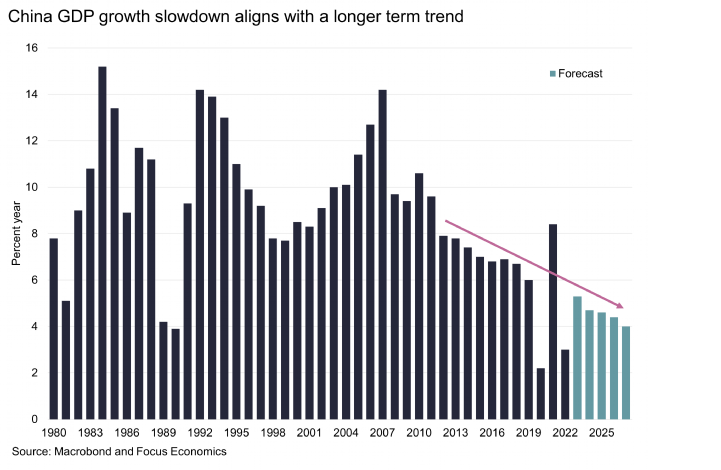
- There remains significant challenges ahead for policymakers in successfully managing this transition, including the very high household savings rate amid an immature social security system, a deteriorating demographic backdrop, and the prospect of technology decoupling on productivity growth. However, something around 5% growth in China is more appropriate given the level of economic development (see chart below, courtesy of ING Research), which would remain very healthy, certainly when compared with Japan’s experience.

Market Monitor
- Despite a relatively hawkish speech from US Fed chair Jerome Powel at Jackson Hole last week – during which he cautioned that inflation remained “too high” and didn’t rule out further interest rate hikes – risk sentiment recovered this week. The principle trigger was a decline in US Treasury yields, underpinned by a continued softening in labour market data, with job openings falling to the lowest level since March 2021. Coupled with a downwardly revised Q2 GDP outturn, this supported a rally in equities, which carried over to global markets. Investors are now pricing in a 90% probability that the Fed sits on its hands at the next meeting later this month.
- Elsewhere, European August inflation data provided no major surprises. The headline rate of 5.3% y/y was unchanged from the previous month, while there was a modest slowing in core inflation. In Australia, July inflation fell below 5%, increasing the prospect of another pause from the RBA next week. Chinese stocks were again buoyed by rumours of more impending government stimulus. And oil prices continue to be supported by a tight supply backdrop, underpinned by expectations that the OPEC+ group of nations will extend existing production cuts to support pricing, as well as falling US inventories.