The Shopping Centre Investment market witnessed a surge in activity in 2014. A total of 100 centres transacted in 2014 representing a capital value of £6.05bn. This is a 32% increase on the £4.58bn traded in 2013.
The shopping centre investment market witnessed a surge of activity in 2014.
"We are already aware of a further 15 shopping centres being prepared for sale in the early part of 2015"
There are also currently 21 shopping centres under offer accounting for circa c£930m and 20 centres in the market accounting for an additional £900m.
We are already aware of a further 15 shopping centres being prepared for sale in the early part of 2015, accounting for a further £500m. What is staggering is that historically we would not have seen new product being prepared for disposal after the end of October in any typical year. 2014 is perhaps a sign of things to come as investors seek to achieve prices that they wouldn’t have been able to achieve over the last six years.
In December alone we were party to eight centres being put to us off market totalling £820m for our clients (some of these centres are not included in the above statistics). To this end we are seeing a larger proportion of assets traded off market or where they are only marketed to two prospective purchasers. Given the competition and resource issue this is proving highly effective from both a timing and pricing perspective for both buyers and sellers.
Notable deals in Q4 2014 involved:
■ The asset swap of Princesshay, Exeter from Land Securities to TIAA Henderson for £128m reflecting 5.6% IY and Buchanan Galleries Glasgow from TIAA Henderson to Land Securities for £137.5m reflecting 5.2% IY 5.5% EY.
■ Acquisition of the Mander Centre, Wolverhampton by Benson Elliot off Delancey/RBS for £58m reflecting 7.25% IY and 6.5% EY.
■ Acquisition of the 50% stake in Highcross, Leicester by Hammerson off clients of LaSalle Investment Management for £216m reflecting 5.5% IY.
■ Acquisition by Chris Lazari of Brunswick Shopping Centre, London off clients of LaSalle Investment Management for £135m reflecting 3.7% IY.
■ Acquisition of Fremlin Walk Maidstone by M and G off L and G for £110m reflecting 6% IY.
■ Acquisition by Hines / HSBC of The Centre, Livingston off Land Securities for £224m reflecting 6.4% IY and 6% EY.
■ Acquisition of Carters Square Uttoxeter off Lingfield Securities by Henderson for £12.3m reflecting 6.14% IY.
Click graph below to enlarge

Q4 2014 saw intense activity in the shopping centre market with increased investor activity and demand for the sector from all quarters.
One of the defining reasons why we believe the market will continue to surge forward in the short to medium term is the fact that we are in unprecedented times from an investor appetite perspective. We have never witnessed a market where all sectors of the investor spectrum are seeking to deploy equity at the same point alongside the debt markets. This is primarily because the sovereign wealth funds and global institutions hadn’t started to deploy equity around the globe until relatively recently.
The key statistics to take away from a comparison between 2013 and 2014:
■ 208% increase in property company trading volumes in £m. This translates to a 50% increase in the number of centres acquired on 2013.
■ 74% increase in opportunity fund trading volumes. This is a 67% increase in numbers of centres acquired on 2013.
■ 20% increase in REIT trading volumes in £m.
■ 16% increase in institutional trading activity in £m.
From a market perspective we believe 2015 will see a slow down in the large loan portfolio sales from the banks. This has been a key feature of the market over the last 24 months. We believe that we will begin to see many of the large opportunity funds start to work out some of their positions – indeed this has already started to happen.
Portfolio sales will, we believe, continue to be a theme of the market. In 2014 high profile portfolios such as Project Swallowtail, The Tiger Portfolio and to a lesser extent Carbon attracted unprecedented levels of interest over the summer months as it enabled the end purchaser to acquire numerous assets and attract strong banking terms.
As yields on the more secondary assets harden we will see a number of the pan European opportunity funds look to other less mature markets to reach their return criteria. To be competitive return hurdles will have to be lowered to “core” levels of c. 10% to be able to compete.
Click images below to enlarge
Q4 2014 saw intense activity in the shopping centre market with increased investor activity and demand for the sector from all quarters.
One of the defining reasons why we believe the market will continue to surge forward in the short to medium term is the fact that we are in unprecedented times from an investor appetite perspective. We have never witnessed a market where all sectors of the investor spectrum are seeking to deploy equity at the same point alongside the debt markets. This is primarily because the sovereign wealth funds and global institutions hadn’t started to deploy equity around the globe until relatively recently.
The key statistics to take away from a comparison between 2013 and 2014:
■ 208% increase in property company trading volumes in £m. This translates to a 50% increase in the number of centres acquired on 2013.
■ 74% increase in opportunity fund trading volumes. This is a 67% increase in numbers of centres acquired on 2013.
■ 20% increase in REIT trading volumes in £m.
■ 16% increase in institutional trading activity in £m.
From a market perspective we believe 2015 will see a slow down in the large loan portfolio sales from the banks. This has been a key feature of the market over the last 24 months. We believe that we will begin to see many of the large opportunity funds start to work out some of their positions – indeed this has already started to happen.
Portfolio sales will, we believe, continue to be a theme of the market. In 2014 high profile portfolios such as Project Swallowtail, The Tiger Portfolio and to a lesser extent Carbon attracted unprecedented levels of interest over the summer months as it enabled the end purchaser to acquire numerous assets and attract strong banking terms.
As yields on the more secondary assets harden we will see a number of the pan European opportunity funds look to other less mature markets to reach their return criteria. To be competitive return hurdles will have to be lowered to “core” levels of c. 10% to be able to compete.
The institutional investors for the most part continue to have cash inflows. We have also witnessed a huge influx of new buyers to the market. Indeed in 2014 there were a total of 64 parties involved in those deals. This included both the equity provider and asset manager.
In 2009 just 18 equity providers/asset managers were involved in transactions.
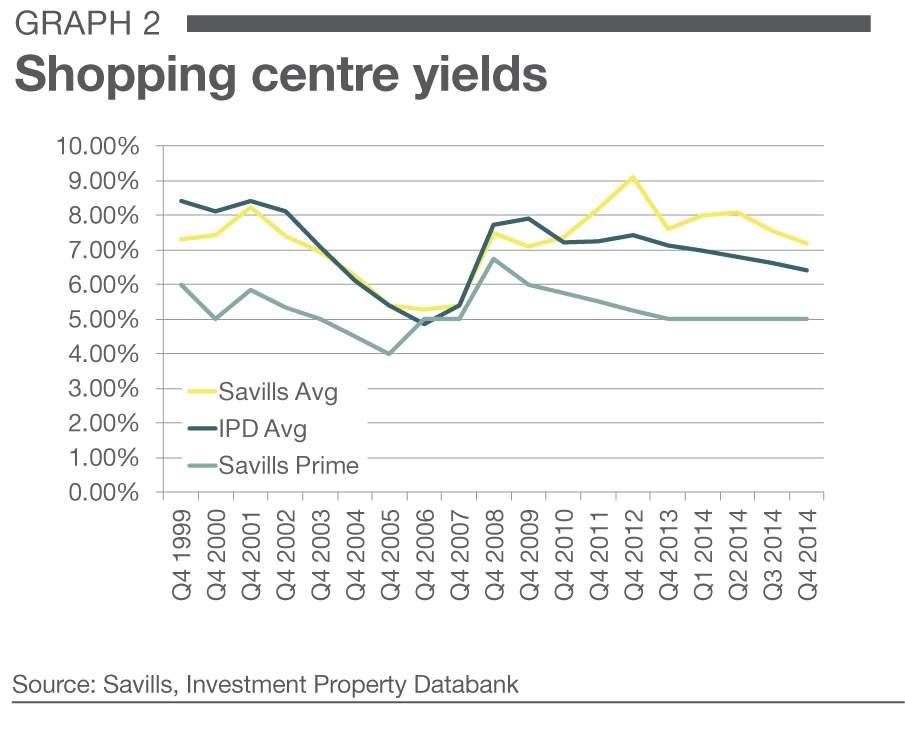
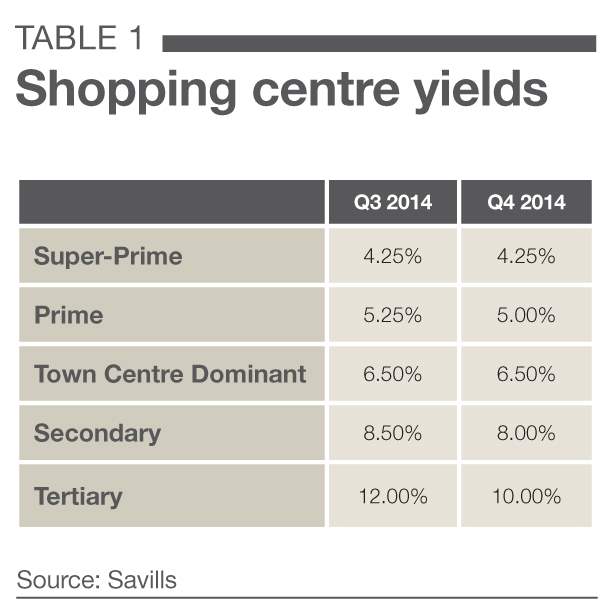
It is encouraging to see that despite the frenetic activity in the sector there is still a very healthy yield gap of c. 575bps between the super prime and tertiary assets. We are not seeing the yield parity of the market sub sectors that we witnessed in 2006-7.
We are also 28% down on trading volumes from the market peak in 2005 where £8.9bn of assets were traded. 2014 has seen super prime yields come in 100bps and Town Centre Dominant assets come in 150bps. 2014 has also shown that the UK shopping centre market is truly on the global investor shopping list with investors from the US, Malaysia, Australia, Canada, Ireland, China and South Africa investing into the sector. We have seen some of the world’s leading sovereign wealth funds and private individuals invest into our top retail destinations.
Click table below to enlarge
As we move through 2015-16 we will see the remnants of the over rented positions in many of the centres rebase to market levels. Once this occurs we will then begin to see rental growth and retail development emerge in the more traditional town centres.
The shopping centre investment team at Savills were involved in 34 transactions in 2014, accounting for 8.9m sq ft of retail in £1.6bn of transactions. This equates to a c.27% market share. The team also has a further four assets under offer, accounting for an additional £460m.