Maturing markets in the US and UK, coupled with concerns over high tuition-fees have led investors to seek new frontiers. Mainland Europe would appear to offer opportunity because of its historically under-provisioned student housing market and much lower tuition fee environment. The question is whether the investment model successfully used in the US and UK can be replicated across Europe.
We have examined the prospects for three of the larger mainland European markets: Germany, France and the Netherlands. The fundamentals of these three markets are, on the face of it, solid. Europe is one of the biggest recipients of international students, and institutions in these countries are actively attracting more by offering courses in English. Importantly, tuition fees are a fraction of those in the major English speaking markets.
However, different locations within these countries can have very different prospects. Investor focus needs to be concentrated on cities, with particular reference to higher education institutions, rather than countries as a whole. In most cities in these countries, the private sector is already well organised to accommodate students, and organisations are in place to act as intermediaries between student and private landlord. Where private, purpose built student accommodation comes into its own is its ability to offer a one stop shop for secure, quality accommodation suited to the needs of international students.
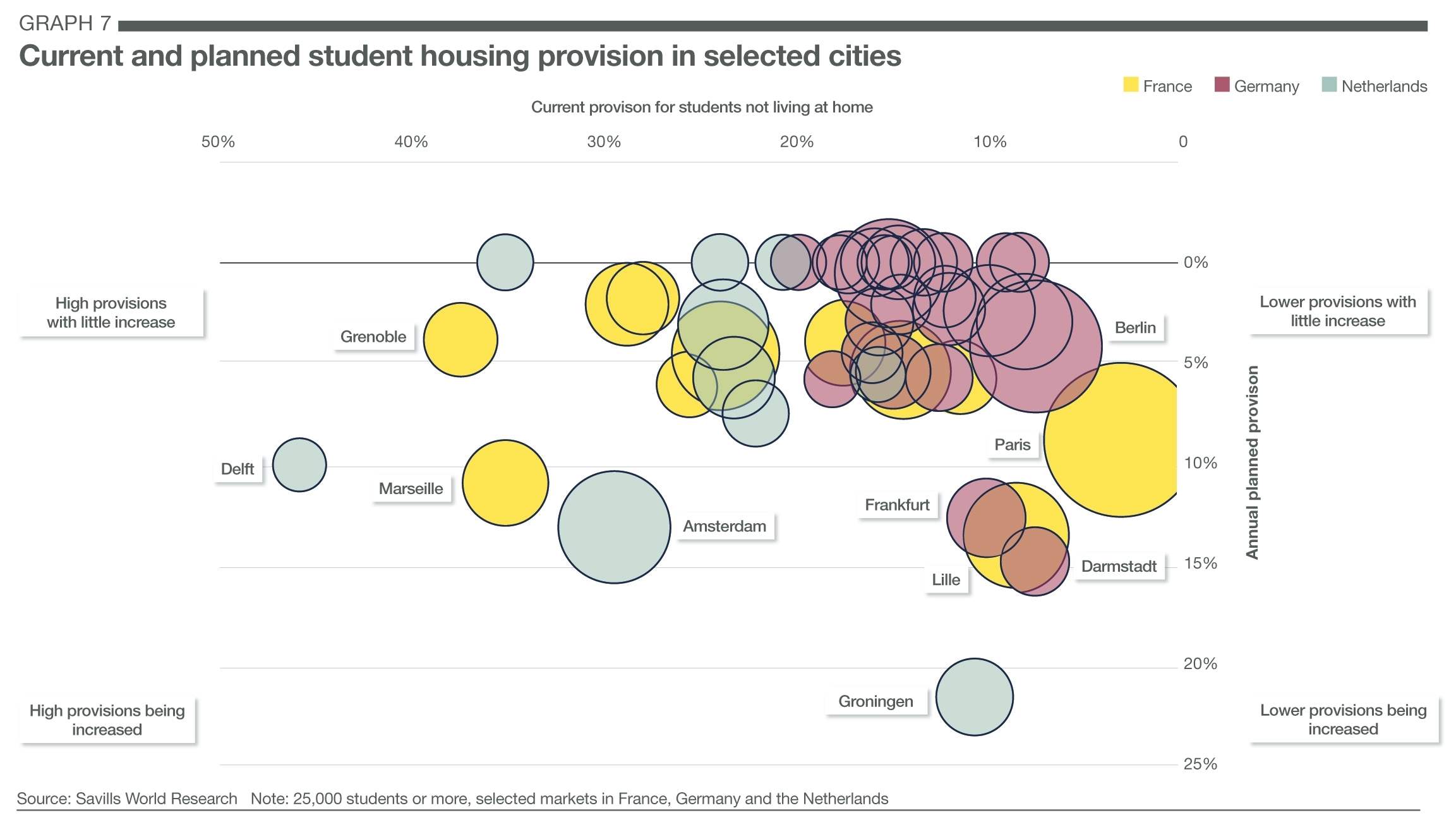
We have analysed current purpose built student housing provision, and development pipeline, in the top student cities of France, Germany and the Netherlands. We set this against the total student population not living with parents in each city in order to identify potential investment sweet spots. So, where do the opportunities for investors lie?