
How Andermatt is leading by example
Fresh air, mountain views and a sporting playground of outstanding natural beauty: a home in the Alps provides healthy outdoor fun year-round. But with around 120 million annual visitors and a corresponding demand for ever-more efficient and modern infrastructure, the impact on this cherished environment cannot be ignored.
Is it possible to combine the undeniable global thirst for a prime Alpine lifestyle with a truly sustainable long-term vision?
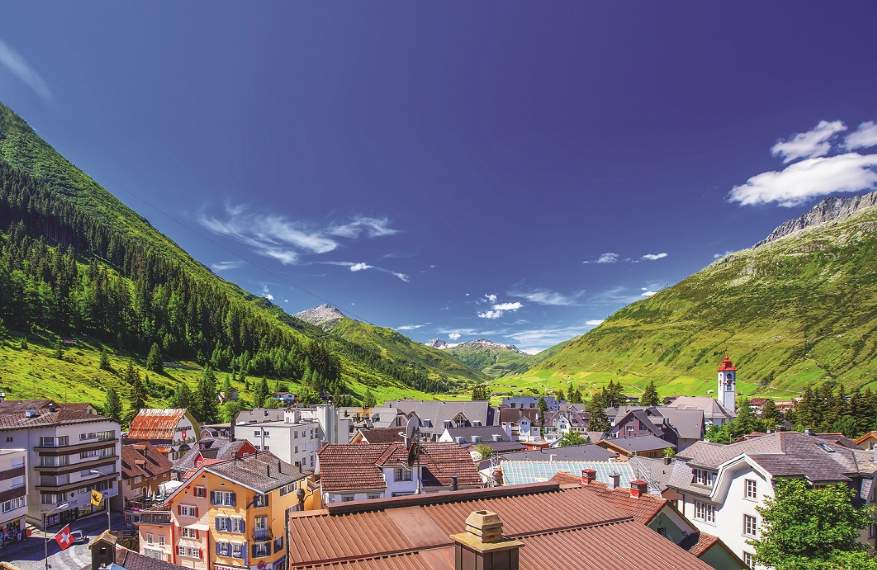
A trailblazing sustainability story is underway at Andermatt in central Switzerland. The small town, 90 minutes from Zurich, is the site of the single largest residential project ever undertaken in the Alps.
For centuries, Andermatt’s location on three mountain passes linking north and south Europe made it a crucial staging post for travellers while its raw natural beauty was eulogised by poet Goethe in the 1780s and, a century later, by Queen Victoria. From the 1880s to the 1990s, the village served as an important military base for the Swiss army but when they left, despite its beauty and handsome traditional architecture, Andermatt required a new vision.
The regional government invited Egyptian property developer Orascom to create a year-round resort suitable for the 21st century, giving unique permission for Andermatt to be somewhere non Swiss property purchasers could buy without a permit. Construction began in 2009 with the aim of adding some 500 homes, five hotels, an 18-hole golf course and transport hub as well as making significant improvements to the skiing arena and lift infrastructure.
Today, under the control of Andermatt Swiss Alps, two hotels are operational, the much-acclaimed Chedi Andermatt and The Radisson Blu. The golf course has been awarded the best in Switzerland multiple times, 19 apartment buildings are complete and the Andermatt Concert Hall is another award winner for its architecture. It’s an impressive catalogue – but what about those sustainability targets?
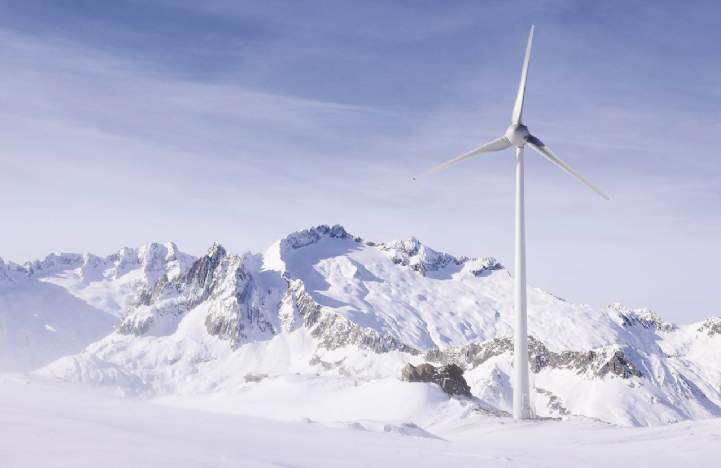
A wind turbine on Rohrspitz above Andermatt. On a windy day, turbines can power the entire lift system
“Sustainability is at the heart of the Andermatt Swiss Alps Group and has been from the outset,” says Stefan Kern, Chief Communications Officer at Andermatt Swiss Alps. “Gaining permission for the development from the national and local government was completely dependent on the project putting energy consumption at the centre of its strategy. If we focus on ecological sustainability and consider energy consumption, 100% of heating in our new buildings is carbon neutral, coming from a district heating plant powered by woodchips. The same goes for electricity which all comes from renewable energy in the region, either hydro or wind power.”
Gaining permission for the development from the national and local government was completely dependent on the project putting energy consumption at the centre of its strategy.
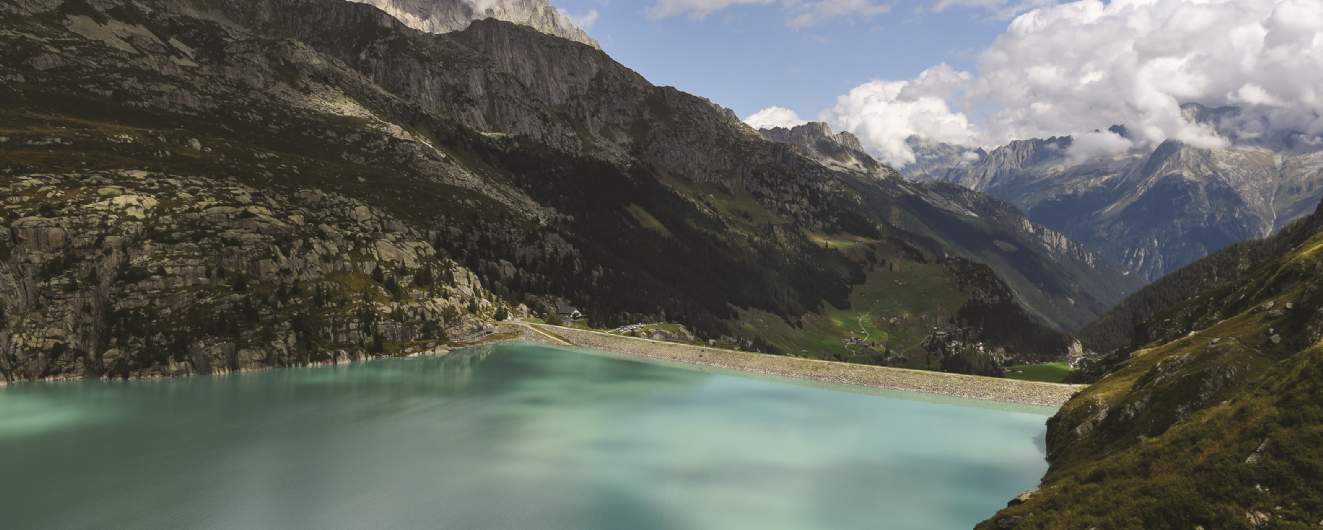
In planning, Andermatt minimised the use of land by constructing the new buildings close together, mimicking traditional Swiss villages while preserving more of the green, natural valley. Lakes are used to provide electricity and make artificial snow, with the water returning to the lake every spring to ensure a neutral balance. And on a windy day, the wind turbines on the mountains can power the entire lift system.
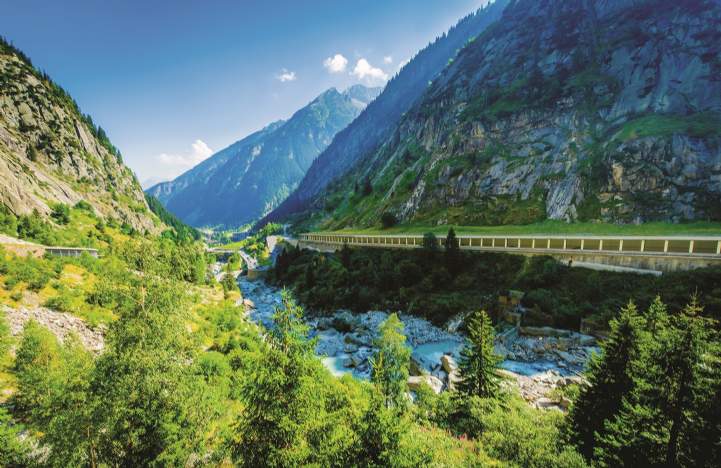
The Passo del San Gottardo. For centuries, Andermatt’s location on three mountain passes made it a crucial staging post
To reduce levels of concrete, wood is used in as much construction as possible and, throughout the resort, buildings must conform to Switzerland’s exacting Minergie standards, set out for all new construction. “That includes thick walls, triple-glazed windows, advanced ventilation systems and a total ban on oil and gas heating,” says Kern.
Andermatt’s train station, with smooth links to Geneva and Zurich airports, encourages visitors on to public transport. The new resort is car free and operates a Mybuxi affordable ride-share system using electric vehicles.
The par-72 championship golf course that meanders dramatically through the meadows of the Ursern Valley has been GEOcertified by the World Golf Environmental Organisation. All golf carts and trolleys are electric, the clubhouse is heated with a geothermal heat pump, and the meadows are carefully monitored to provide homes to endangered bird species. The course received the highest level of sustainability rating from Switzerland Tourism in the autumn of 2023.
At Andermatt we only use recycled paper for printing … staff uniforms are made ecologically, and we ensure all soap scraps from our hotels are repurposed and given to those in need.
While renewable power and talk of carbon neutrality might capture the sustainability headlines, smaller details are important too. Waste, recycling and traffic are the principal focus for Mountain Riders, a French not-forprofit organisation founded in 2001 working to improve awareness and education around environmental issues in the Alps. They identify the resorts following best practice by considering their policies on recycling and traffic reduction. Chamonix and Méribel score well here, both providing free shuttle services, while Morzine in the Portes du Soleil has implemented traffic-free zones in the village alongside a park and ride scheme.
In Flims and Laax in Switzerland, all meat served in their restaurants comes from Switzerland, coffee is only fairtrade and organic, plastic straws are banned and food waste is carefully monitored to prevent future overspending.
These smaller aspects of sustainability carry real value, agrees Stefan Kern. “At Andermatt we use only recycled paper for printing and our golf course uses biodegradable unpainted wooden tees rather than plastic ones,” he says. “Staff uniforms are all made ecologically and we partner with a company to ensure all the soap scraps from our hotels are repurposed and given to those in need.”
Andermatt Swiss Alps can claim to have one of the most extensive sustainability policies in the Alps, publicly reviewing its carbon footprint every year to evaluate progress. Its efforts are clearly important to the local municipality who voted with an overwhelming 96% majority to embrace the project in 2007. But how important are they for international buyers?
“Until recently it didn’t seem a priority for buyers, who focused more on design, space and location,” admits Kern. “But that’s changing as the effects of global warming become more apparent worldwide. And there’s clear additional value when we show potential owners that the measures will impact future utility costs. So yes, it makes a difference on both a financial level and increasingly on an emotional level, the importance of doing the right thing.”
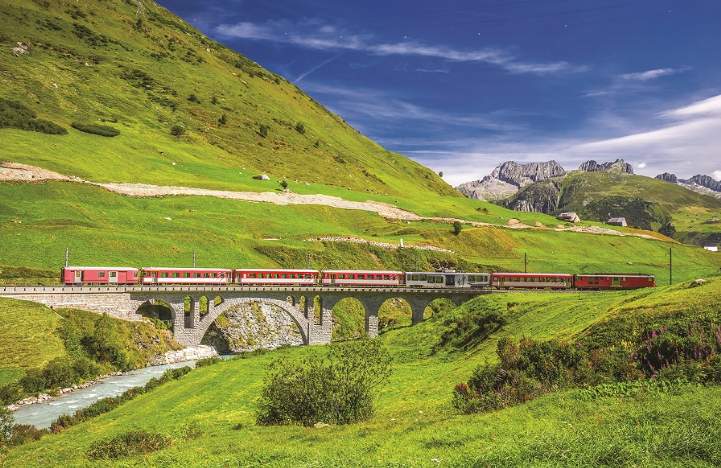
The Matterhorn-Gotthard-Bahn train on the viaduct bridge near Andermatt
Strides in Swiss sustainability
Several Alpine resorts are trying to improve their sustainability status. Veysonnaz in the Swiss Valais is halfway through an ambitious and disruptive two-year project that will not only provide an attractive redesign of the village centre, adding green spaces and pedestrianised areas, but also introduce a new network of underground water pipes. On completion, these will supply hot water and heating to homes throughout the town using renewable sources, such as woodchip.
In Switzerland’s eastern Graubünden canton, authorities in the resorts of Flims, Laax and Falera aim to eliminate all operational emissions by 2030, pledging to change from being an “energy consumer to an energy producer”. They will replace fossil fuels and “meet all the region’s energy needs by regionally produced, 100% renewable energy”, setting out a six-point plan that includes decarbonising existing buildings, using solar architecture, electrifying vehicles, building power plants for hydro, photovoltaic and wind, and improving energy storage.
This winter, Flims is also the location for the world’s first “on-demand” ski lift. The FlemXpress gondola will run cabins only when requested by waiting skiers and let them choose one of two final destinations. It means no unnecessary journeys with empty cabins, with an energy saving of 50% over the chairlift it replaced.
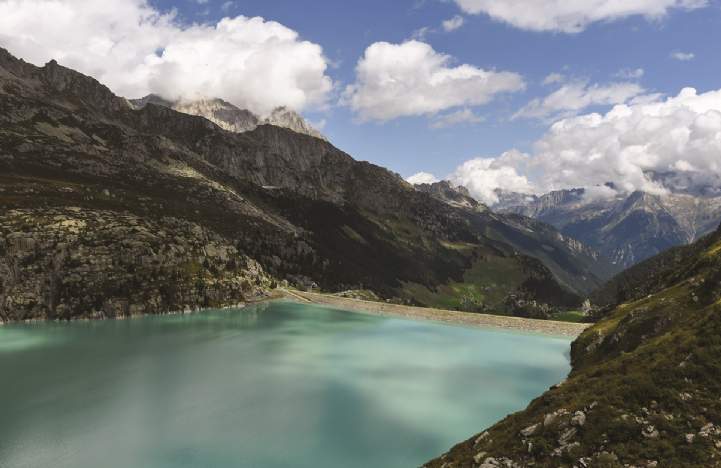
Göscheneralpsee lake. All electricity in the region comes from hydro or wind power