

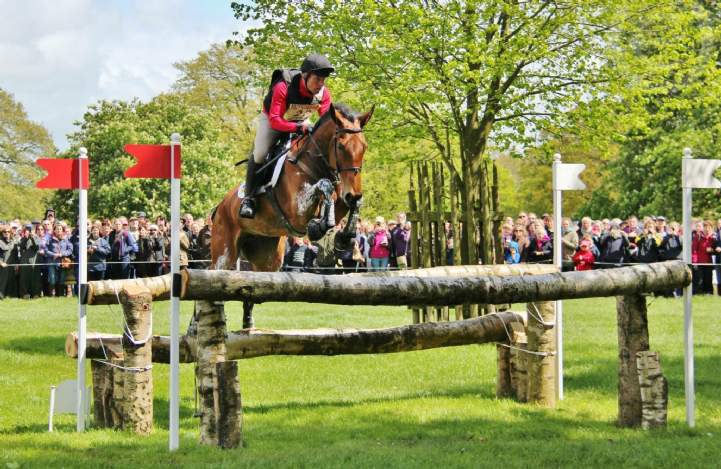
Tell us a bit more about yourself and your career highlights to date.
I have been a professional event rider for the last 20 years representing the Dutch team at a number of Championships including the European Championships in 2011 and 2013, the 2012 London Olympic Games and the 2014 World Equestrian Games where I won a team Bronze medal. I still compete at the top level however I have branched out into other areas of the sport. I am coach to the Dutch Olympic Team and over the last few years I have started course designing.
How did you get into course designing?
I am based at Somerford Park Farm which is a top class training facility in Cheshire. They asked me to help with the design of some new cross country schooling fences so I got my basic course designing qualifications. I really enjoyed the designing and it quickly escalated from the schooling fences to designing full competition courses.
I have designed a number of courses for national competitions including Tweseldown, Bradwall, Rolleston and Somerford. I have also been involved with a number of top level tracks including Bramham, Chatsworth, Burnham Market, Strzegom in Poland and The Maryland Horse Trails in America.
In your opinion, what is the best type of land to design a cross country course on?
Estate style parkland is every course designers dream. The terrain provides the optimum test and allows us to be creative with the track. You can set out fences using the various natural mounds and undulations, whether that be fences into spaces, optimising different cambers, using different light and shade elements by jumping in and out of woodland or being able to use natural water sources, it means that you can create a course that is interesting for both horse and rider, and of course the spectators.
While we aim to challenge the competitors, a good designer endeavours to create a track that is exciting and educational for both horses and riders so building in a variety that asks different questions is really important.
How do you design a track with the safety and welfare of the horses and riders in mind?
That is a big challenge in the sport. There are a number of things that have been invented to try to make the sport safer including the mim clips and frangible pins. We follow strict design guidelines and use the clips and pins so that some fences will be forgiving should a mistake be made by horse or rider.
How does the cross country test differ in the modern CCI format compared to the old roads and tracks?
It is a very different sport now which requires a different type of horse. The endurance phase is less influential. When I first started eventing, you needed an old fashioned steeple chase type with plenty of thoroughbred for the roads and tracks, steeple chase and cross country phase. Now we see more continental breeds that jump and move well but don’t necessarily have the same stamina.
What would be the one piece of advise you’d give to aspiring course designers?
I am still an aspiring course designer.. however, I have always tried to learn from as many different people as possible. I have been really lucky and had the opportunity to work with some of the greatest in the sport including Ian Stark, Mark Phillips, Eric Winter, Mike Etherington-Smith and David Evans.
I have ridden around hundreds of tracks by designers from all over the world and I think that exposure really helps. I also think that the longer you keep riding, the better informed you are from a design point of view.
Lastly, it is the 75th anniversary of Badminton Horse Trials next week, who will you have your eye on and why?
It will be interesting to watch Piggy March, she has a lovely horse called Brookfield Innocent that she thinks a lot of. Ros Canters’, Izilot DHI that won at both Blenheim and Pau last year is certainly one to watch and will take a lot of beating. Unfortunately we do not have any Dutch competitors at this year’s event however those are two British competitors I will be looking our for.