
Farnham residential property market: research and insight on residential values, trends and forecasts
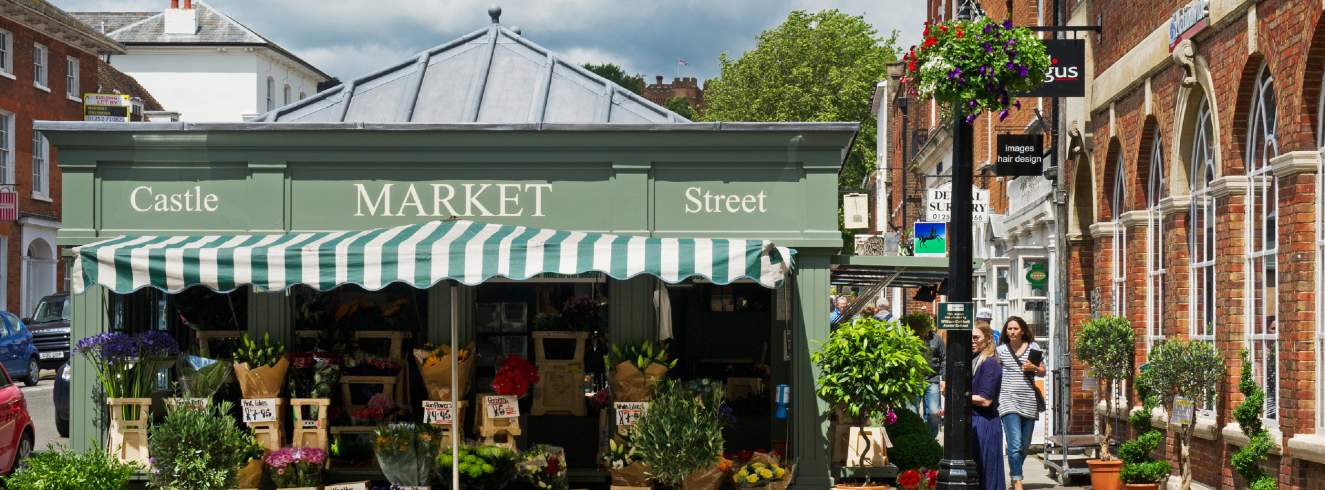
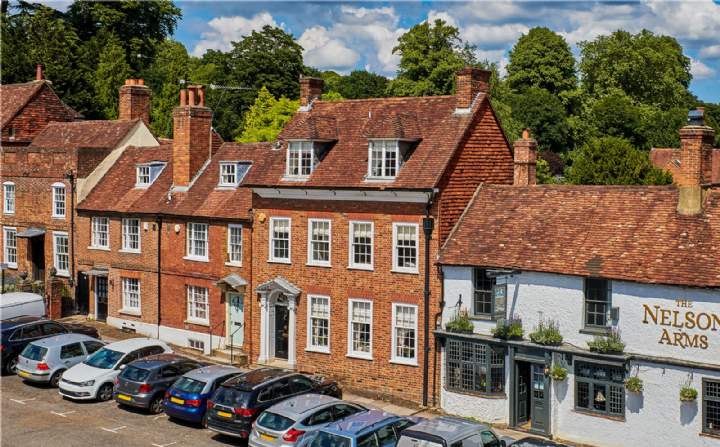
Farnham and its surrounding areas offer strong commuting routes into nearby London, with access to a variety of shops, restaurants and leisure activities. Renowned for its long-held association with the creative arts, the town hosts prominent displays of public artwork and is home to some notable architecture. This can be seen in its varied offering of period mansions, cottages and new build properties.
Local prices
The average second hand sale price in Farnham was £625,040 in the year to November 2024, according to the Land Registry. Compared to neighbouring towns, this was higher than in nearby Aldershot (£311,137), in Farnborough (£371,175) to the north, and in Guildford (£583,636). However, average prices were higher in Chiddingfold (£796,552) to the south east, over the same period.
Average second hand sale price across Farnham, 12 months to November 24
Property prices across Farnham range between £450,00 to £965,000. The highest value neighbourhood falls within the electoral ward of Farnham Bourne, where values average £960,341, having increased by 10.2% over the last five years. Meanwhile, overall property values across Farnham have grown by 14.3% since 2019.
Turning to Farnham’s surrounding areas, the highest value neighbourhood is the village of Thursley, with an average house price of £1,226,250. For comparison, the average property in Waverley, the local authority where Farnham is located, is valued at £621,152. In other nearby villages across the borough, such as Frensham, Chiddingfold and Goldaming, values range between £509,559 and £1,113,900.
Average second hand house price, by civil parish
Prime sales market
Confidence is gradually returning to the prime regional markets of the UK, as mortgage rates improve and inflation continues to remain within the Bank of England’s target threshold.
Prime prices across Farnham and its surrounding areas increased by 0.3% over the first three months of 2025; a greater increase than over the same period in 2024 (0.2%) and in 2023 (-1.5%). As such, house price growth averaged out at -0.5% over the 12 month period to Q1 2025, a significant increase on falls of -7.0% over the year to Q1 2024.
Since September 2022, financial pressures and economic uncertainty have impacted market conditions. As a result, prices have fallen by -9.7%, since the Q3 2022. However, values remain up by 8.7% since December 2019, pre-pandemic, higher than the 5.6% average for the outer commute zone, the region which covers Farnham and the local area.
Farnham and its surrounding areas typically attract needs-based, domestic buyers looking to upsize. As such, 59% of Savills buyers in this location were upsizers in 2024.
Prime lettings market
The prime rental market across Farnham and its surrounds saw rents rise by 5.9% over the first three months of 2025, an increase on falls of -2.6% over the three months prior.
The recent uptick in rental growth can be attributed to changing market conditions, with the return of the family market locally, as well as pre-pandemic migratory patterns placing pressure on local supply. As such, rental growth averaged out at a marginally positive 0.2% in the year to Q1 2025.
The rental market in Farnham and its surrounding areas typically attracts tenants looking to upsize and relocate. But affordability pressures and the announcement of VAT on schools fees in the Autumn budget resulted in some tenants becoming more conscious of their budgets. Equally, Farnham also holds an appeal to certain families, drawn by the strong mix of local schools As such, rental prices for houses outperformed flats across the outer commute zone as a whole over the year to Q1 2025.
Outlook
Overall, the prime regional markets are witnessing improved sentiment as mortgage rates and economic conditions continue to stabilise.
Throughout 2025, we expect price growth across the prime regional markets to be driven by additional base rate cuts. As reduced mortgage rates and improved sentiment are expected to drive demand in those areas with more debt-reliant buyers.
Additionally, whilst the application of VAT on school fees since January may put additional pressure on some household budgets, we continue to forecast positive growth of 18.2% across the prime regional market over the five years to 2029. It must also be noted that some locations with strong educational provision may benefit from increased demand.
For the prime rental market, we continue to expect demand to be determined by the balance between supply and demand. A shift in market sentiment, with increased regulation through the Renters’ Rights Bill, has prompted some uncertainty from landlords and will put upwards pressure on rents, as supply becomes more limited. However, our five year forecasts remain robust, anticipating 12.6% rental growth over the prime regional rental market over the period to 2029.
Savills Farnham track record
Six properties we sold and let in your area
.jpg "York Place")
.jpg "York Place")
LET
Castle Street, Farnham
Guide letting price £4,500 per month