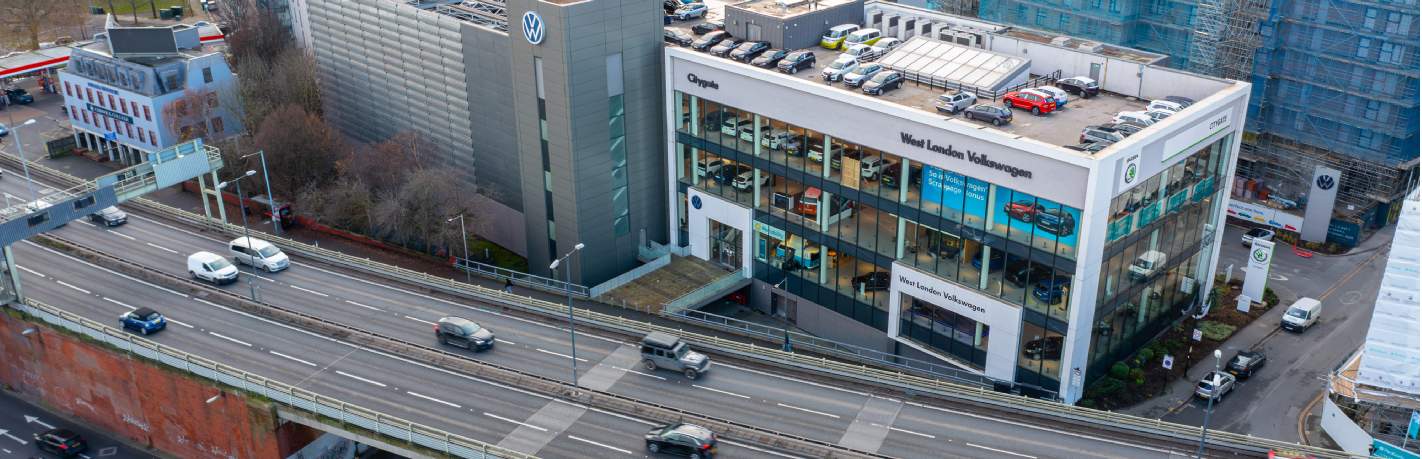
While car sales have remained steady, dealership property fortified its position as an essential in the vehicle sales process, and it continues to attract foreign investment.
In May, there was once again a rise in overall new car registrations – the 22nd consecutive month of growth. This has largely been driven by fleet and business demand (SMMT), which is propping up the new car market.
Battery Electric Vehicle (BEV) market share rose to 17.6% in the month and 16.1% year-to-date (SMMT). The growing supply of BEVs is encouraging, however, lagging consumer demand means that the market is still below the quota assigned to manufacturers – which requires 22% of new vehicle sales to be zero emission for this calendar year. This means that some of the traditional brands with a more suppressed range of BEV models are unlikely to meet the target and could incur significant fines. There is, however, now a plethora of BEV models available to consumers, with affordable offers. As supply ramps up and BEV stock continues to pile up in UK ports, manufacturers will be forced to sell these in ‘push strategies’ at even lower prices to fuel private demand and meet the Zero Emission Vehicle mandate quota. There are a number of new market entrants performing well, particularly those from China where electric battery production is cheaper and more efficient. For example, BYD has had an approximate 2,500% increase in market share yearto-date, outperforming Tesla which is down 12.55% market share year-to-date (SMMT). BEV production and sales are not at all plain sailing, with Californian based manufacturer Fisker reportedly up for sale. This proves that a good brand and model needs strong financial support.
The general transition to electrification requires wider government support, particularly directed towards electric vehicle charging infrastructure – which remains one of the key factors suffocating private demand for BEVs.
The private market is still lagging, with used car supply and margin constraints producing a 12.9% decline in private retail uptake (SMMT). This is impacting dealer profitability – alongside prevailing inflation, interest rates and high energy costs. However, some of these pressures are expected to ease as we reach an economic point of inflection, with many commentators forecasting an interest rate cut. The prolonged stagnation in new car sales has impacted used car supply and ultimately sales performance, evidenced by the closure of a number of used car sales outlets. This includes some of Sytner’s ‘CarShop’ and Inchcape’s ‘bravoauto’ sites, albeit the majority of the latter are being acquired for continuing automotive use. Online used car giant Cazoo has entered administration which can in some ways be put down to stock issues, but more prevalent is the ideology that dealers and their bricks and mortar are an inherent part of the car sales process. As private demand catches up with the improving new car supply, used car stock will follow in returning to the market.
Mercedes has lost market share in its first year of implementing an agency model. This is a new system whereby the customer places the order directly with the Original Equipment Manufacturers (OEM) (usually) and their dealer partner is the conduit for delivery of the product to the consumer – as well as responsible for the aftersales relationship and servicing care. This does not necessarily herald a warning sign for this model, rather, it shows that in tough environments there will likely be integration challenges initially.
Dealers are stating that a ‘quasi-agency’ model will only benefit the manufacturers. A true agency model requires full price transparency enabling omni-channel sales, with the dealer as the final avenue of delivery. Dealers, by definition, get deals done – and the development and full integration of the model will be crucial to its success and ultimately dealer profitability.
As the UK automotive sector has resiliently navigated the economic headwinds over the last couple of years, there has been a clear doff of the cap and a backing of the sector from foreign investors. There has been some Arabic and Asian investment, but more prominent and notable investment has come from North America. That includes the Lookers takeover by Canadian Alpha Auto Group, the Jardine acquisition by US group Lithia – as well as proposed purchase of Inchcape UK’s cardealerships business from Group 1 Automotive, also heralding from across the pond. The UKmarket is particularly attractive to foreign investors due to the number of freehold property assets held within the dealer group businesses. This is comparably much higher than the likes of the European market – where the number of freehold assets held by dealer groups is saturated by higher rates of sale and leaseback activity.
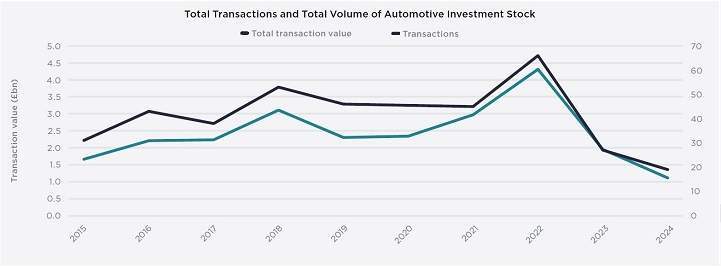
The start of 2024 saw a 60% improvement in the number of investments for car dealership property, compared to the last quarter of 2023. That’s despite being behind the start of an average year and a subdued performance of the wider commercial property sector. If the continued trend of activity continues throughout 2024, it is likely to see almost a 50% increase in transactions compared to that of 2023, with investors confident of broader economic recovery. Regardless, this activity has come with a noticeable increase in the average car dealership investment yield currently at 7.2%, compared to that of 2023 at 6.51%, largely explained by the overhang of the stock from 2023 being shifted following repricing. This compares with the 10 year average yield of 6.26%. Nevertheless, the overhang of the stock from 2023 has largely now shifted throughout the start of 2024, largely being repriced.
Funds continue to be the net seller of the asset class, with private buyers’ property companies accounting for 50% and car dealers accounting for the other 50% of the buyers in the sector – taking advantage of the lack of fund interest and better yield pricing. Car dealers are realising that acquiring the freeholds of leased property has many benefits – including reducing overheads and cementing their position in the property.
As shown on the graph below, total transactions for 2024 remain below that of 2023, but with 4 months to go, it’s likely that the year will finish above 2023 transactional level, however will still be below the 10 year average. Now with a new Government in charge and interest rates, dropping from 5.25% to 5.00%, activity in the market is expected to increase, with the likelihood of yield improvement expected to follow, with buyers returning to the market, creating competitive bidding.
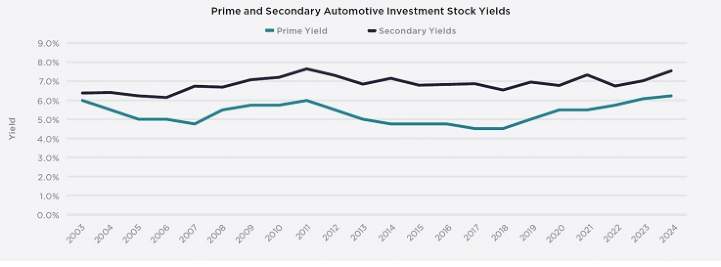
Prime yields continue to be the hardest hit area, due to the long-term lease lengths usually acquired by the funds where there is aforementioned subdued acquisition activity. Higher private and property company acquisition activity, combined with a distinct lack of fund interest, has led to a narrowing of the gap between prime and secondary yields – as the graph below shows.
A number of assets are starting to come to the market or are being prepped for launch, with several becoming available due to mergers and acquisitions within the property sector. This type of activity is expected to continue throughout the market, which will bring with it a variety of opportunities and the likelihood of increased stock levels for the rest of the year.