
Since the abolition of the debt cap on the Housing Revenue Account for local authorities in 2018, town halls have been forging ahead with plans to help meet local housing need. Well over half of councils have established housing companies and many are exploring capacity within their own HRAs.
Savills estimates that the financial capacity released by the removal of the debt cap could deliver 150,000 – 300,000 homes over time. In addition, Homes England has just announced £55m in grant for 12 local authorities to build 4,000 homes. Council house building has not been seen at this scale in more than a generation.
At the same time Local Authorities continue to invest in their existing homes to ensure they provide safe, modern, affordable environments for communities to flourish.
To give themselves the best chance of delivering their ambitious aims for growth, and balance this with the need for investment in their existing stock, local authorities need to ensure they maximise their capacity. The first step in this process is understanding your assets: land, existing homes, garages, commercial etc.
Savills has been helping social housing landlords to evaluate the performance of assets for many years. We use our SHAPE model (Savills Housing Asset Performance Evaluation) and ensure it is kept up-to-date with the latest business intelligence to keep in tune with client needs.
We have modelled over 820,000 homes across England and Wales. Our coverage across England in just the last four years is shown below.
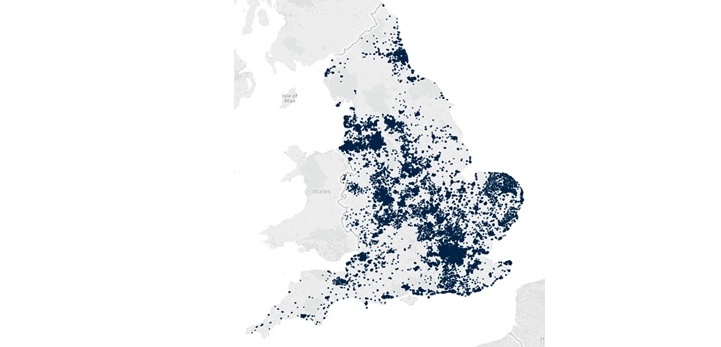
Fig 1: Savills asset modelling coverage – England 2015/16 – 2018/19
Here are some of the ways SHAPE is already helping local authorities deliver their objectives for new and existing homes:
- Housing growth and regeneration: Local authorities are using the modelling to improve HRA business plan capacity, meaning more money for new homes. The modelling also provides a transparent process for balancing investment decisions between new build and existing homes. A well-rounded performance evaluation, which incorporates a range of neighbourhood factors, can be the starting point for identifying opportunities.
- Physical standards: There is now a clear emphasis on physical standards, from fire safety to energy efficiency and environmental improvements. These are all aspects we might expect to see in any revised decent homes standard. SHAPE modelling can be used to build up a firm business case for improvements. For example, we are supporting some landlords to look at how SAP ratings and fuel poverty vary across their properties. SHAPE can then test different scenarios for improvement based on impact on NPV, but also social return. This is showing how demand is influenced by neighbourhood environment and how investment in this can improve NPVs through reduced voids and anti-social behaviour.
- Resident trust: One obvious area where SHAPE is proving valuable is helping organisations to communicate with residents and other key external stakeholders in order to build trust. For instance, asset managers can help their organisation demonstrate the rationale behind decisions taken about where to invest and where not to.
- Delivering social objectives: Local authorities are using SHAPE to understand the extent to which assets are helping them to meet their social objectives, from affordability to sustainability. This can help to inform decisions around the bricks and mortar, but also help to target community investment where it can deliver the most benefit.
As local authorities develop their plans for growth, attention is turning to what else is possible. What more can the robust collection and analysis of data tell people about how to plan improvements in their local neighbourhoods?
If you would like to learn more about our SHAPE model, how it can support your growth and regeneration plans, or about how your current performance compares with our national and regional benchmarks, please let us know. We are exhibiting at the CIH Housing 2019 conference in Manchester in June, or please use our direct contact details below.
- 820,000 homes in England and Wales analysed by SHAPE
- 150,000-300,000 homes could be built using new HRA freedoms
- £15bn of additional financial capacity could be available through HRAs
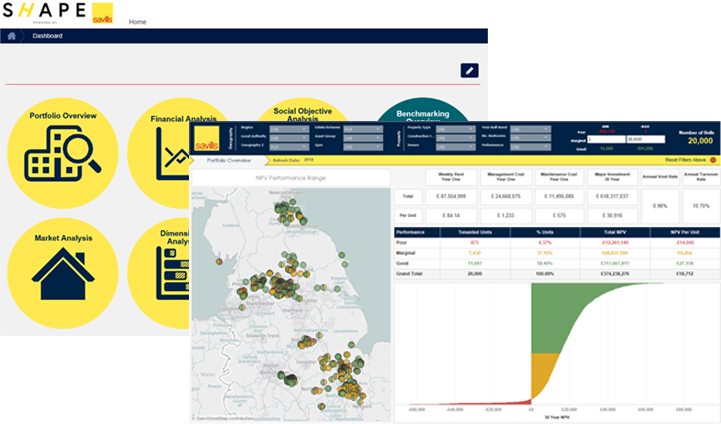
Most landlords use a measure of net present value of operating cashflows to consider the ‘worth’ of each property to the business plan over the long term. Our system goes further projecting how NPVs will move in future, looking at operating margins, yields and the ratio of social to market value. It also includes a measure of performance compared with social objectives. This is critical if performance is to be assessed against the specific aims of a social housing landlord.
Case Study:
Slough Borough Council
Savills undertook a complete SHAPE analysis of Slough’s 6,000 council homes in 2018. The work identified that there were a number of potential opportunities to undertake more detailed appraisals for development and/or redevelopment. A key feature of the work was Savills’ ability to link performance outputs on existing stock to the availability of vacant sites (for example small infill or garage sites) within the HRA and the council’s wider ownership, with both of these mapped against our extensive market value database for individual localities. This insight allowed the council to quickly identify those areas with the greatest potential for redevelopment opportunity in areas where there was poorer performing existing stock, vacant land and stronger values to assist the redevelopment strategy. Two estates of two tower blocks have subsequently come forward for redevelopment.
John Griffiths, Housing Development and Contract Services Lead at Slough Borough Council, said: ‘Savills has been a trusted partner to the council in helping to bring forward our extensive development and redevelopment programme of 900-plus homes in the next five years. The work Savills undertook on the detailed asset performance evaluation of the HRA stock at Slough, alongside a review of the development potential for garage sites and open spaces, has been critical in facilitating our programme. They have also worked with Slough to carry out a series of follow-up appraisals of opportunities for redevelopment and regeneration.’