The strengthening of Scotland’s life science sector is clear to see, says Savills, with over £600 million raised for life science companies, headquartered in Scotland, in the last three years. The latest data from Pitchbook, analysed by Savills, presents the capital raised in the life science sector across the UK, see Chart 1, and highlights Scotland as an emerging centre of excellence in the UK.
While Edinburgh and Glasgow account for 50% of the total number of capital raising deals recorded in Scotland since 2018, Aberdeen is highlighted by Savills as ‘one to watch’ as an emerging life science cluster with the total raised in 2020 being 17% above what was raised, in total, during the previous two years. Savills stipulates Aberdeen data is currently based upon fewer deals than Glasgow and Edinburgh, but the growth shows that larger capital raising transactions can happen in the city.
Chart click here - Life science related venture capital raised in the rest of the UK including Wales and Scotland (£m)

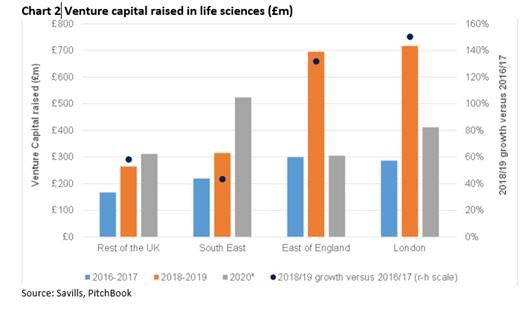
London, the South East and the East of England regions continue to dominate the UK’s life science sector, says Savills, with the latter two regions driven by the strength of the Oxfordshire and Cambridgeshire markets. See Chart 2.
Steve Lang, research director at Savills, comments: “With the global hunt for a cure to end the Covid-19 health pandemic, there has been a significant increase in the level of interest from all corners of the market to understand the future role of the life science sector. From a real estate perspective, in the UK it is interesting to see where there is growth.
“The UK is very good at discovery within a life science context. R&D capabilities have grown significantly and the presence of global companies in the country is noteworthy. While the Universities of Cambridge and Oxford will see the South East and East of England remain the core locations outside of London for a very long time, there are pockets of growth elsewhere in the UK that should not be ignored, and we recognise Edinburgh, Glasgow and Aberdeen as three such cities.”
Key venture capital raising deals in the life science sector in Scotland in 2020 include:
- Pheno Therapeutics, a developer of therapies and drugs intended to repair damage to the nervous system. The company, spun out by world leading academics from the University of Edinburgh, raised £5 million of funding in February. The funds will be used to investigate potential multiple sclerosis treatments.
- Nod-Thera, operator of a clinical-stage biotechnology company intended to develop medicines to treat diseases driven by chronic inflammation, headquartered in Aberdeen, with an office in Cambridge, raised c.£44 million in June a deal led by Novo Holdings.
- Roslin Technologies, a joint venture between the University of Edinburgh and two investment and business development partners, launched a £50 million capital raise in July. The agriculture biotechnology company specialises in core capabilities including genome sequencing, gene editing, transgenics, phenotyping and bioinformatics offered as a service to clients and used to create sellable products, thereby providing food producers with sustainable protein production across the livestock and aquaculture sectors.
Hugh Rutherford, director in the business space agency team at Savills in Edinburgh, comments: ““Edinburgh is particularly well placed to take advantage of the essential critical mass and unique mix of bioscience, health, clinical sciences, education and increasingly the close links developing between technology and bioscience. This latter linkage will be crucial going forward and will benefit from recent City Deal funding.”
Dan Smith, head of the Aberdeen office at Savills and director in the business space team, comments: “Momentum to reduce the reliance on Oil and Gas in the North East is building and through my role at Savills and my involvement on the Policy Council of Aberdeen Grampian Chamber of Commerce, I see first-hand the swathes of initiatives supporting diversification in the local economy. With an established talent pool and essential critical mass, Aberdeen is well positioned to support the growth of life sciences in the area which, together with Hydrogen and renewable energies, can deliver a sustainable employment platform for our city going forward.”
Commenting on Glasgow, David Cobban, head of Savills Glasgow and director in the business space team, adds: “Glasgow has embraced the life science sector and continues to attract emerging businesses to grow in the City due to capacity. The City recognises the importance of collaboration in this sector and is working hard to create the opportunity to cluster close to teaching institutions or large medical facilities such as the Queen Elizabeth University Hospital. Given the structural challenges facing the business sector during this pandemic and post-Covid the Life Science sector, even more than ever can start to increase its contribution to the Glasgow economy.”
Overall the UK is ranked in fifth place for top performing countries in the pharmaceutical and biotechnology sector and accounts for 7% of total global corporate R&D investment (€154 billion in 2019), according to data from the European Commission.
Chart click here - Venture capital raised in life sciences (£m)