

CHALLENGE
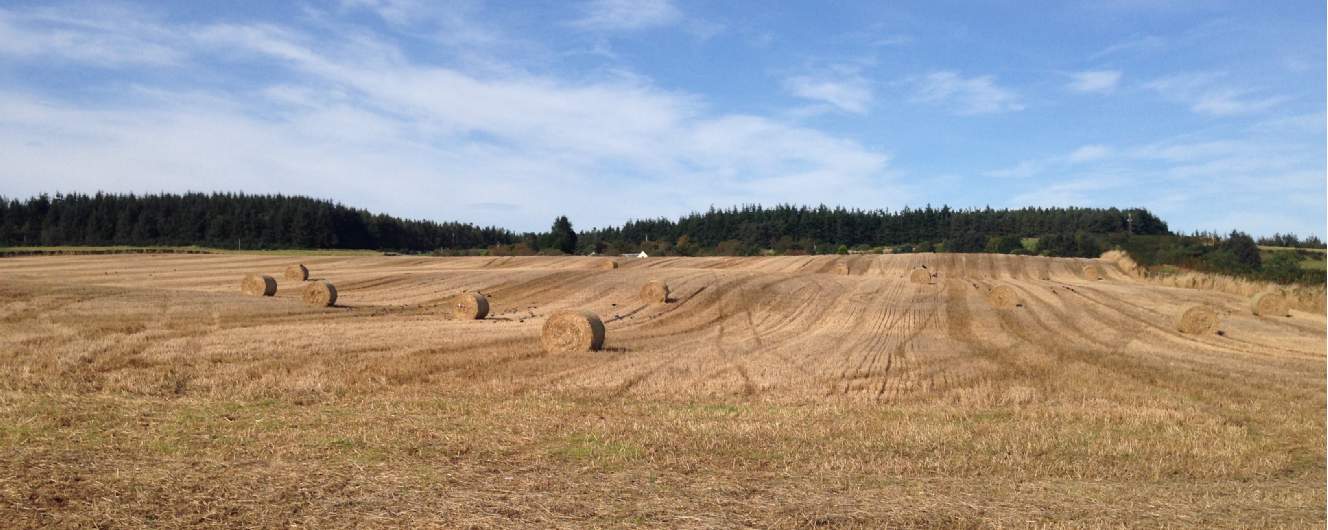
To promote approximately 21.5 hectares of agricultural land south of Laurencekirk through the Aberdeenshire Call for Ideas and Sites process. Our role was to undertake a high-level feasibility and constraints assessment, Biodiversity Enhancement assessment, advise on the site’s development potential, and prepare a submission demonstrating its ability to deliver much-needed housing and community infrastructure, including a burial site.
Our priority was to develop a genuinely sustainable and deliverable scheme that balanced commercial viability with planning and environmental priorities. This included providing high-quality family homes, recreation space, blue-green infrastructure, Biodiversity Enhancement, and strong connectivity to the existing settlement.
Both the design approach and submission needed to align with the objectives of NPF4 by responding to the climate and nature crisis, whilst supporting Aberdeenshire Council’s vision for sustainable growth, local living, and deliverable development. The proposal also needed to demonstrate how it could address local needs and contribute positively to a broad range of policy objectives, including Biodiversity Enhancement.

SOLUTION
Biodiversity Enhancement was integrated into the scheme’s design from the outset. An initial review of habitat mapping, records and planning policy identified areas of higher and lower ecological value, as well as opportunities for enhancement. These findings informed refinement of the site boundary and guided discussions on the location and nature of development, open space and blue-green infrastructure.
Following NatureScot guidance, we used the English BNG Metric (in the absence of a published Scotland-specific tool) as a proxy to assess habitat value, supported by a qualitative appraisal of ecological connectivity, ecosystem service provision, climate resilience and community benefits. Applying the mitigation hierarchy, the most valuable habitats, principally woodland, were retained and opportunities for long-term enhancement identified. Working closely with the master planning team, access infrastructure, including paths and interpretation boards, were designed to encourage engagement with nature whilst protecting sensitive habitats from recreational pressure. We directed development towards lower-value habitats and embedded a multifunctional green-blue infrastructure network of biodiverse SuDS, increased tree cover, species-rich grassland and orchards, and successional habitats to deliver Biodiversity Enhancement alongside community and climate benefits.

RESULTS
The proposed framework demonstrates how housing and environmental enhancement can be delivered together. Rather than simply minimising impacts, the scheme was thoughtfully informed to deliver measurable environmental and community benefits. The scheme provides approximately 150 new homes and new cemetery, and a multifunctional green-blue infrastructure network informed by local needs and priorities. By integrating a mosaic of habitats, the masterplan is expected to deliver an estimated 10% biodiversity uplift whilst building climate resilience through ecosystem service provision and strengthening links within the wider nature network.